Protection in times of crisis: how Ukraine should guarantee the rights of persons with disabilities in humanitarian response
January 19, 2026
Share:
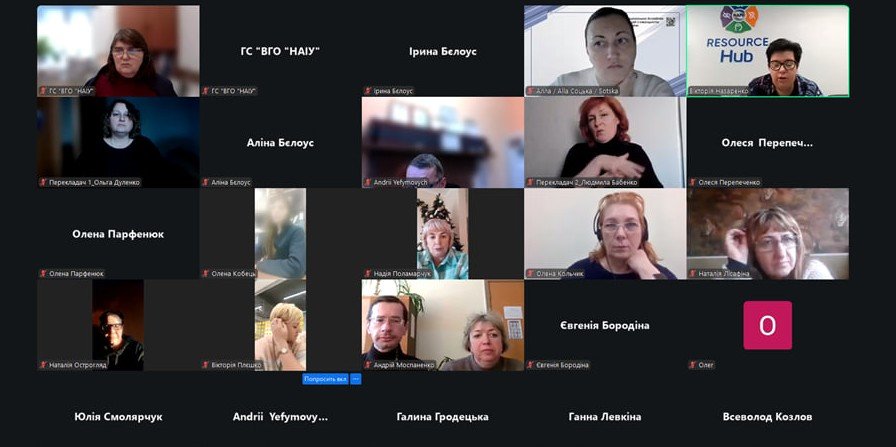
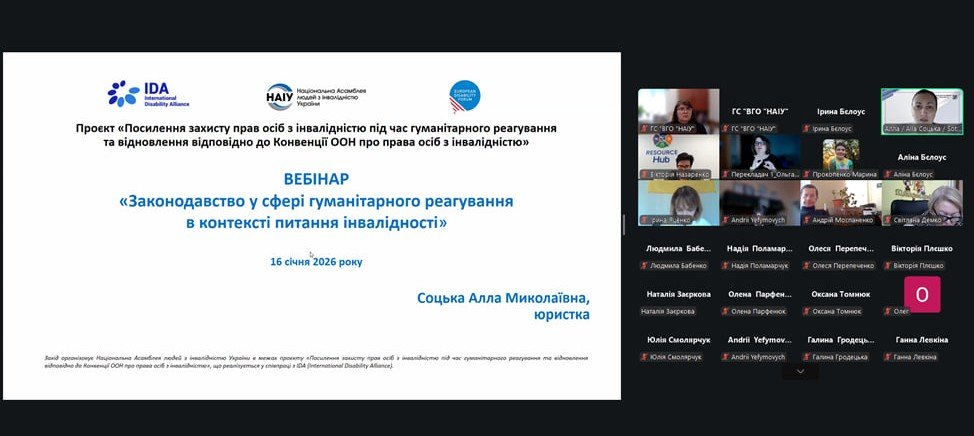
The National Assembly of Persons with Disabilities of Ukraine held a webinar entitled “Legislation in the field of humanitarian response in the context of disability,” dedicated to the analysis of international standards and national legislation that define the specifics of protecting persons with disabilities in emergency situations, including war. The event was organized as part of the project “Strengthening the protection of the rights of persons with disabilities during humanitarian response and recovery in accordance with the UN Convention on the Rights of Persons with Disabilities” with the support of the International Disability Alliance (IDA).
The main objective of the webinar was to familiarize participants with international and domestic regulations that contain requirements and guarantees for compliance with the main principle of humanitarian response-accessibility of assistance for all, without discrimination, taking into account the needs of persons with disabilities and other low-mobility groups of the population.
As noted by the webinar speaker, NAPD lawyer Alla Sotska, Article 11 of the UN Convention on the Rights of Persons with Disabilities, which has been ratified by our state, imposes certain obligations on Ukraine. These include ensuring the protection and safety of persons with disabilities in situations of armed conflict and humanitarian emergencies. The participants reviewed the provisions of the Geneva Conventions and Additional Protocol I, which enshrine special protection for the wounded, sick, and persons with disabilities, guarantees of evacuation, and access to medical care and support from humanitarian organizations.
The audience was also presented with a systematic overview of Ukrainian legislation in the areas of civil protection, social services, healthcare, education, and the protection of IDP rights. In particular, they examined the Civil Protection Code of Ukraine, which guarantees, among other things, notification of emergencies, free evacuation using specialized transport, etc. It also provides for the establishment of accessible temporary accommodation and the provision of humanitarian, medical, psychological, and material assistance to all those in need.
An important point of emphasis at the meeting was the information that regulatory acts on alerting directly require the use of audio, visual, text, and sign language formats of communication that are convenient for people with disabilities, and that evacuation and accommodation plans have separate sections dedicated to their needs.
At the same time, regulations stipulate that ramps in shelters are not a recommendation but a requirement, and navigation to protective structures must be duplicated in Braille and tactile format. People with disabilities have priority rights to evacuation, accommodation, and continued residence in temporary shelters.
The audience discussed mechanisms for the emergency (crisis) provision of social services, compensation for caregivers, and the development of resilience centers and assistance centers for survivors.
As emphasized during the webinar, legislation explicitly defines public organizations of persons with disabilities and social service providers as recipients of humanitarian aid, and also provides for the possibility of providing persons with disabilities with vehicles recognized as humanitarian aid.
Participants representing organizations of persons with disabilities from different regions of Ukraine shared their problems that they have to solve locally. According to them, the legislation contains a significant number of tools to ensure the rights of persons with disabilities, but not all of them can be implemented in practice, mainly due to insufficient control over their implementation in the regions.
According to the participants, the webinar became a platform for professional discussion of humanitarian response issues in Ukraine: how to make it truly inclusive and compliant with international human rights standards, even in the most difficult conditions.
The project “Strengthening the protection of the rights of persons with disabilities during humanitarian response and recovery in accordance with the UN Convention on the Rights of Persons with Disabilities” is being implemented by the NAPD within the framework of a grant from the International Disability Alliance (IDA). International Disability Alliance (IDA)
Повернення з військової служби до цивільного життя — це новий етап, який нерідко супроводжується непростими викликами. Особливо для ветеранів і ветеранок, які зазнали поранень або набули інвалідності. Реабілітація, пошук роботи, доступ до послуг, відновлення соціальних зв’язків — усе це потребує не лише особистих зусиль, а й підтримки суспільства. Національна Асамблея людей з інвалідністю України (НАІУ) […]
Упродовж програмного року — з 1 жовтня 2025-го до 30 вересня 2026-го — на гарячій лінії Національної Асамблеї людей з інвалідністю України (НАІУ) було надано 821 консультацію для 680 осіб. Найчастіше люди зверталися за роз’ясненням щодо своїх прав і пільг, зокрема отримання та поновлення виплат, оформлення догляду, встановлення й переоформлення інвалідності. Близько 70% звернень стосувалися […]
2 вересня 2026 року Генеральна Асамблея ООН ухвалила резолюцію 80/305 «Доступ до асистивних технологій». Це важливий крок до того, щоб технології, які допомагають людям навчатися, працювати, спілкуватися та жити самостійно, стали доступнішими в усьому світі. Сьогодні понад 2,5 мільярда людей потребують асистивних технологій. Це, зокрема, крісла колісні, слухові апарати, засоби комунікації та інші пристрої, які […]
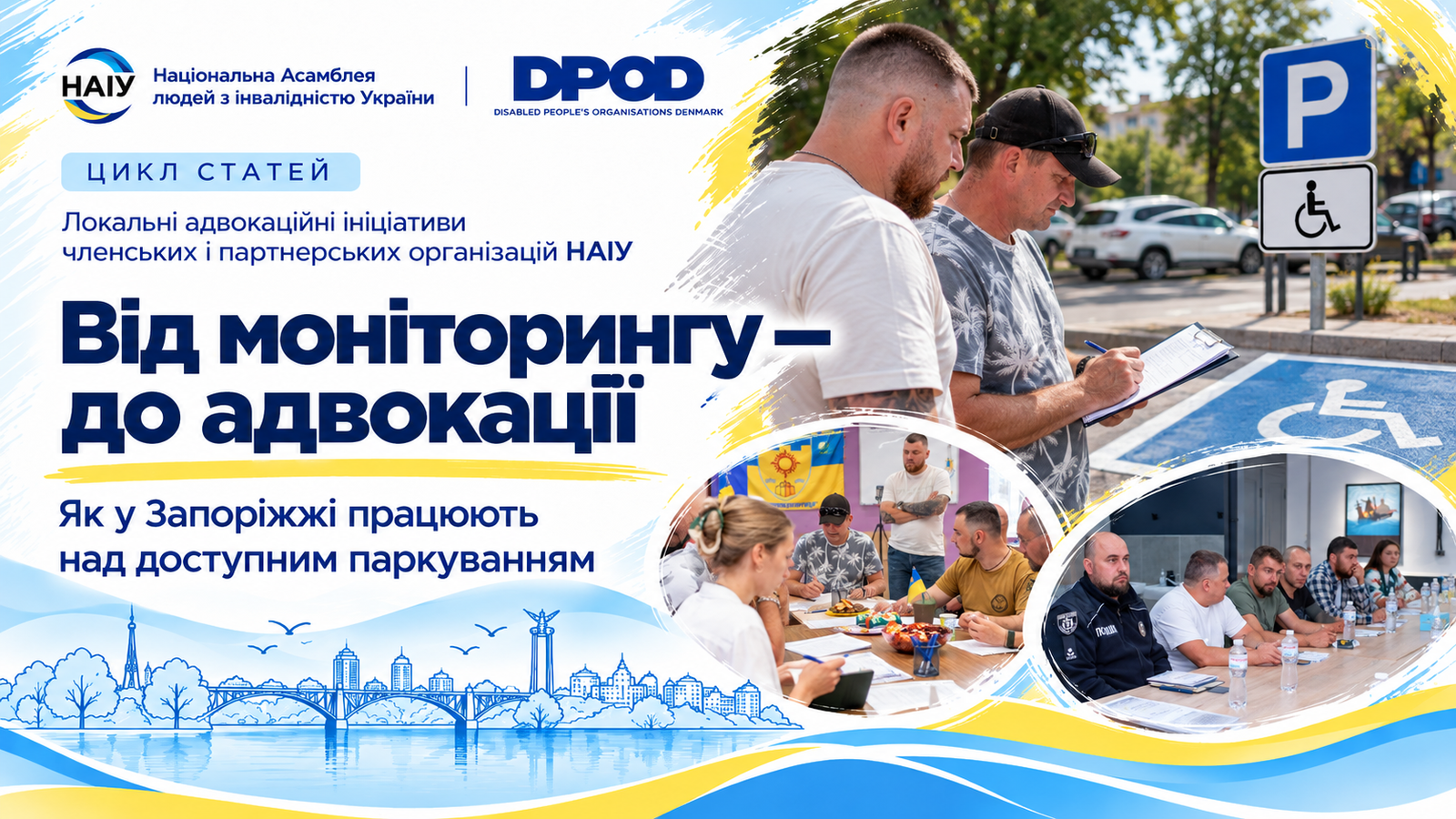
НАІУ продовжує цикл матеріалів про локальні адвокаційні ініціативи членських і партнерських організацій за підтримки та фінансування Disabled People’s Organisations Denmark (DPOD). П’ята історія — про досвід запорізької ГО «СИЛА РОЗВИТКУ», яка порушила питання доступності паркувального простору та відповідального паркування. Паркомісце для людини з інвалідністю — це не просто питання зручності. Якщо воно зайняте, неправильно облаштоване […]
13 жовтня 2026 року з 11:00 до 13:00 відбудеться друга лекція в межах проєкту «Голос жінок і лідерство: нова сила», присвячена розвитку світового та українського феміністичного руху в контексті захисту прав жінок з інвалідністю. Тема зустрічі – «Феміністичний рух світу та України крізь призму захисту прав жінок з інвалідністю». Феміністичний рух у світі та Україні пройшов тривалий […]
Іноді потрібна послуга є — але людина не знає про неї. Інформація опублікована — але її складно зрозуміти. Лікарня працює — але до неї важко дістатися. Цифровий сервіс доступний — але скористатися ним самостійно може не кожен. Саме з таких повсякденних ситуацій розпочалася адвокаційна робота Інгулецької районної організації ветеранів м. Кривого Рогу в межах проєкту […]