The international meeting “Humanitarian Reset and Organisations of Persons with Disabilities” served as a platform to discuss the profound transformation of the humanitarian system amid a financial crisis, growing needs, and a shrinking humanitarian space. At the center of the discussion were localization and the meaningful participation of organisations of persons with disabilities (OPDs) in decision-making processes.
A representative of the secretariat of the Inter-Agency Standing Committee (IASC), Fitsum Assefa, outlined that since 2025 the humanitarian system has been facing a sharp decline in funding alongside increasing complexity of crises. The humanitarian reset process envisions: more precise identification of needs, faster and more accountable aid delivery, devolution of power closer to communities, and protection of international humanitarian law and civilians.
The key principle of the reset is “as local as possible, as international as necessary.” However, the participation of local organisations in Humanitarian Country Teams stands at only 11%, and in clusters at 19%. This is precisely where organisations of persons with disabilities can and must play a decisive role.
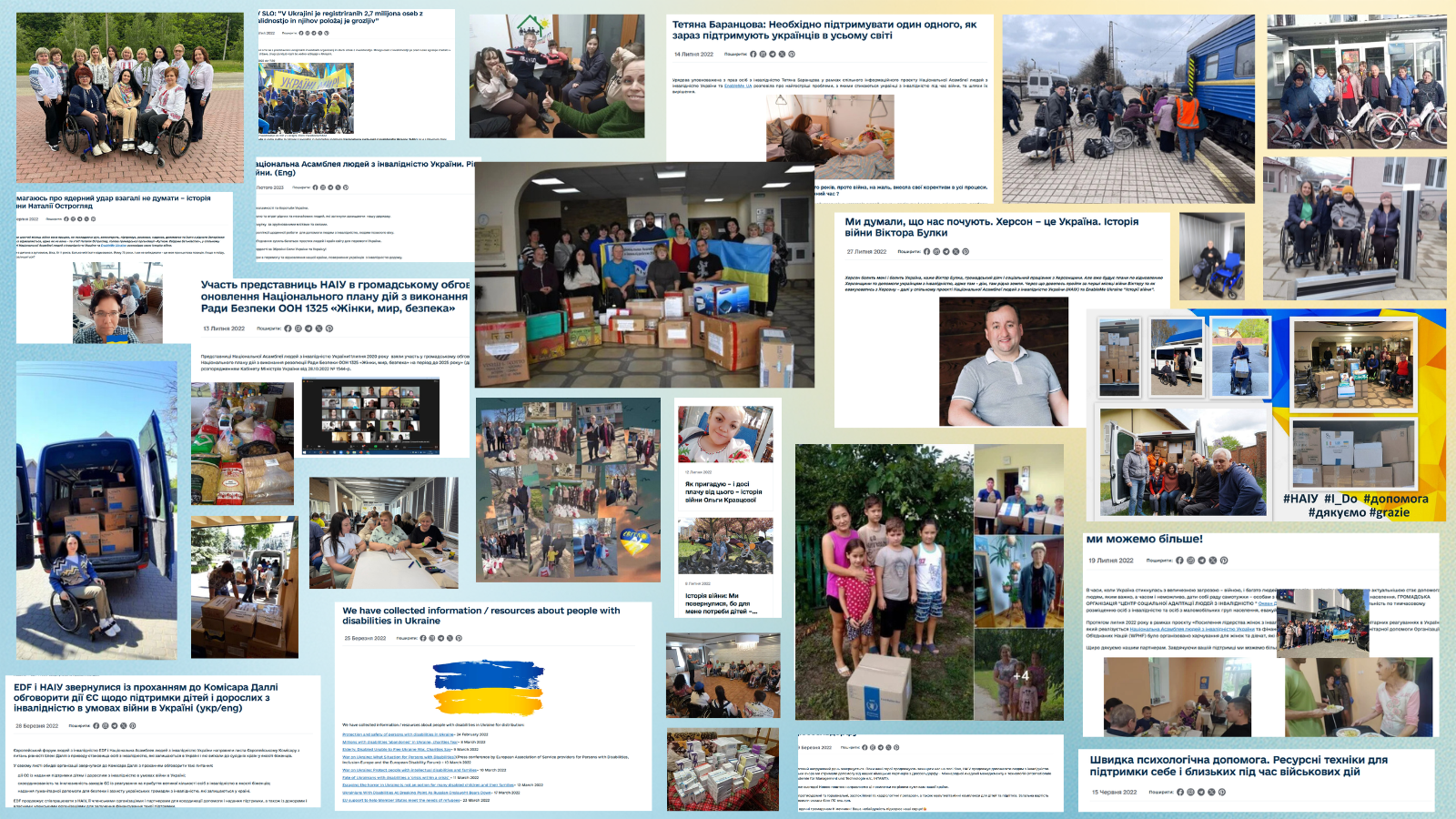
Larysa Bayda, Programme Director of the National Assembly of Persons with Disabilities of Ukraine (NAPD), spoke about what inclusive humanitarian response looks like in practice. NAPD brings together more than 100 organisations of persons with disabilities and operates in nearly all regions of the country. Approximately 60% of its current work is focused on humanitarian response.
Ukrainian organisations of persons with disabilities have developed an approach based on the inclusion of persons with disabilities in collective planning at the community level. This enables targeted assistance and strengthens its sustainability, ensuring that disability and inclusion are systematically addressed. Access to information for persons with different types of impairments, access to services (education, healthcare, social services), physical accessibility, and transport accessibility are all core areas of our work when operating at the community level.
Another crucial component is the training of professionals and public officials. Equally important is support for local organisations of persons with disabilities and activists from vulnerable groups. This involves not only financial support but also strengthening their capacity to influence decision-making.
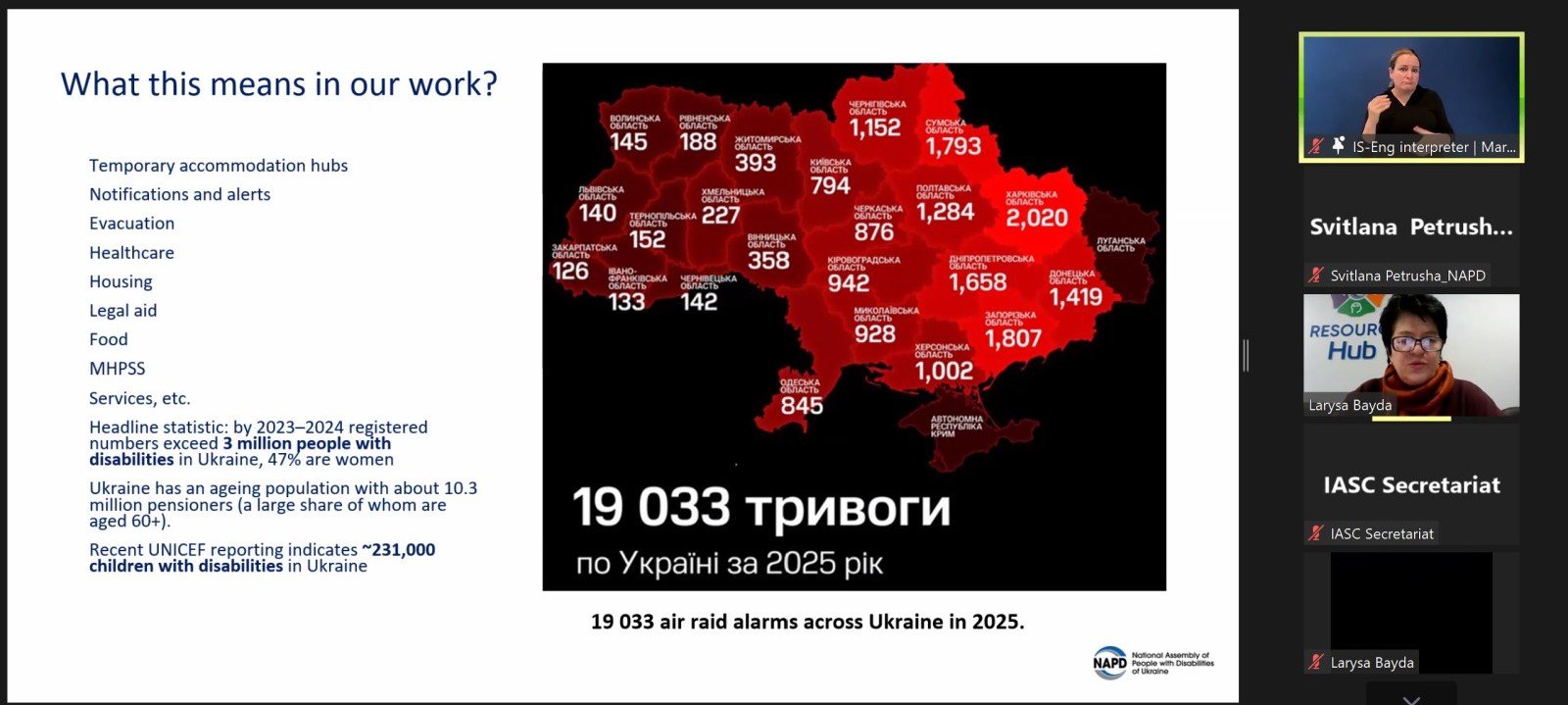
According to official data from 2023–2024, more than 3 million persons with disabilities are registered in Ukraine, 47% of whom are women. Ukraine also has approximately 10.3 million pensioners, a significant proportion aged 60 and above. According to UNICEF, around 231,000 children with disabilities require support. These numbers continue to rise daily as a result of the war.
Air raid alerts, evacuations, destruction of infrastructure, and power outages all disproportionately affect persons with disabilities.
Larysa Bayda shared the story of a mother from Kamianets-Podilskyi who is raising a child with a disability. In her appeal, she asks a simple yet painful question: how can one live when persons with disabilities remain invisible?
She speaks about buildings without ramps or elevators, about mothers who must carry their adult children in wheelchairs down from upper floors during shelling, risking their own lives. About the absence of adapted housing. About support that ends at the age of 18, as if the need for medical equipment and care disappears with adulthood. About exhausted mothers who simply want their children to live — in a reality where prices rise constantly and support remains unstable. This voice is not an isolated case but a symptom of a systemic problem.
In her speech, Larysa Bayda emphasized that persons with disabilities are not a homogeneous group and must not be perceived solely as aid recipients.
Disability must be treated as a cross-cutting issue across all humanitarian response strategies — from planning to monitoring.
The Ukrainian experience demonstrates that organisations of persons with disabilities are capable not only of delivering assistance but also of shaping policy, influencing priorities, and ensuring data quality and accountability.
The humanitarian reset creates an opportunity for genuine localization. However, without the systematic participation of organisations of persons with disabilities in coordination mechanisms, without access to funding, and without a shift in management culture, this process risks remaining declarative.
The Ukrainian experience shows clearly: inclusion is not an additional option. It is a measure of the effectiveness of the entire humanitarian system.
Oleksandra Perkova, communications manager