Sometimes change begins not with major renovation works, but with a simple question: Is it convenient for everyone to access this information, enter the premises, understand the task, or ask for support?
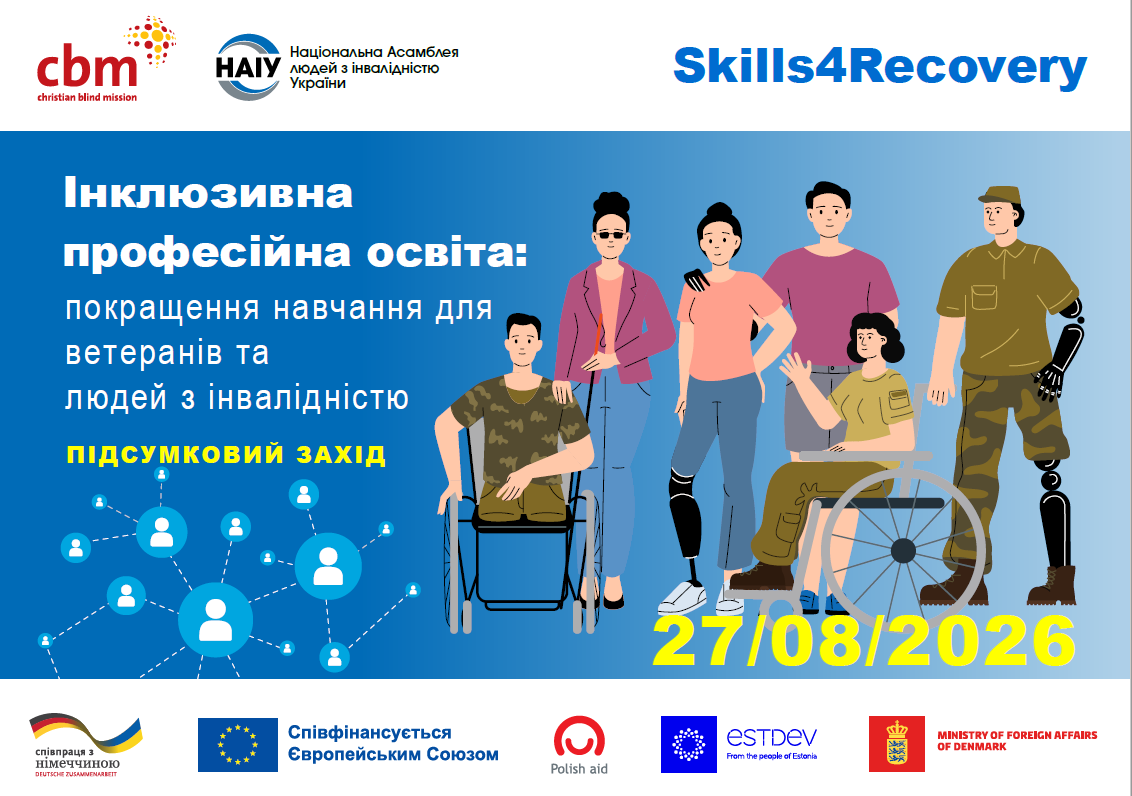
After the training on inclusive vocational education and training, many participants began asking themselves exactly these kinds of questions. They are representatives of vocational education and training (VET) providers participating in the project “Inclusive Vocational Education and Training: Improving Training for Veterans and People with Disabilities” within the Skills4Recovery Multi-Donor Initiative.
During the supervision sessions, they spoke not only about ramps or accessible entrances. The discussions focused on the language of communication, websites, presentations, learning materials, the behaviour of educators, and the first conversation with a prospective learner.
The article uses feedback and statements shared by project participants during the supervision sessions. This helps to show not only the content of the training, but also how the knowledge gained is influencing the everyday work of VET provider teams.
This article is about how a professional perspective changes. Inclusion begins when an institution’s team starts seeing barriers that previously seemed invisible.
To See Not a “Person’s Problem”, but a Barrier in the System
One of the most important conclusions reached by the participants was that inclusion cannot be the responsibility of a single specialist alone. It is not a separate area of work or an additional option. It is an approach that applies to the entire work of an institution.
This is about how learning is organised, how information is presented, how the website functions, and how the team communicates with students, parents, and employers. It is equally important how the institution prepares to train veterans, persons with disabilities, adult learners, and people with diverse life experiences.
“Inclusion is the transformation of the entire system. It concerns all of us, not only individual students. Impairment is not the students’ problem; it is a problem of the institution and society.”
This conclusion changes the logic of action. If the barrier is not within the person, but in the environment, then the task of the institution is not to wait for the “ideal learner”, but to create conditions for different people.
The First Conversation Can Also Be Inclusive
One of the most powerful changes concerns language and communication.
After the training, the participants became more careful in choosing their words, acting less from a position of pity and more from a position of respect. This is particularly important during the admission campaign, when a person contacts an institution for the first time.
“I realised that persons with disabilities do not need to be pitied or offered help too insistently. This may offend a person.”
One of the female participants shared a story that clearly demonstrates the practical result of the training:
“Today, our first applicant came to us — a young man with a disability who does not have one of his limbs. I spoke with him calmly; I knew which words to use and how not to offend him with pity. We communicated as equals. Now I feel as if I have grown wings.”
This is not merely an emotional story. It is an indication that a teacher or institutional representative can welcome a person without fear, awkwardness, or excessive care. A person does not come for sympathy. They come for a profession, support, and an opportunity to build their future.
Accessibility Is Not Always Immediately Visible — One Has to Learn to Notice It
After the training, participants began to see accessibility not only in their own institutions, but also in everyday life: in the street, on public transport, in public spaces, and in learning materials.
“I now constantly notice elements of universal design and accommodations around me — in the street, on the train, and in public spaces. Now I clearly understand what they are and for whom. It broadens my world.”
This attentiveness is important for a vocational education and training institution, because a barrier is not always obvious to someone who does not encounter it.
For someone, small print is a minor detail. But for another person, it is the reason they cannot read important information. For some, complex language on a website is merely inconvenient. For others, it is an obstacle on the path to admission.
A Website, a Presentation, and a Font Are Also Part of Accessibility
Accessibility is often associated with renovations, lifts, or ramps. These are indeed important. But information accessibility is no less important.
For an applicant, a website, announcement, or presentation may be the first point of contact with an educational institution. If the information is complicated, too small, unclear or inaccessible to persons with visual impairments, the person may simply not take the next step.
After the training, participants began reviewing the presentations, learning materials, promotional announcements, and websites of their institutions.
“I regularly prepare and adapt learning materials. Now I am more selective when choosing fonts and colours so that they are convenient for everyone. Previously, I did not pay attention to these aspects.”
Another example is the updating of an institution’s website:
“Our institution’s website is currently being updated. And the first thing I asked was: where is the adaptation of fonts and colours? We must take into account different ways in which people perceive information.”
Change begins not only in classrooms, but also in the way institutions communicate. Accessible communication directly affects whether veterans, persons with disabilities and other learners are able to find out about available learning opportunities.
Do Not Lower Expectations — Change the Approach
Another important conclusion from the supervision sessions is that inclusive learning does not mean lowering standards. It means finding another way for a person to demonstrate their knowledge and skills.
If a learner finds it difficult to answer orally, they can be offered a written task. If the material is difficult to absorb, it can be presented in smaller parts. If a task is complex, visual prompts or step-by-step instructions can be added.
“If something does not work, it is not about the child — it is a signal to look for a different approach.”
This approach is useful not only for learners with special educational needs. It improves the quality of learning for everyone.
From Personal Change to Team-Level Change
After the training, the knowledge gained did not remain with individual participants only. Institutions began holding internal discussions, sharing materials with colleagues, reviewing documents, adapting information materials, and preparing for the admission campaign.
In some VET institutions, internal teams or “mini-methodological councils” on inclusion are being formed. During open house events, some institutions already openly state that they are ready to admit persons with special educational needs.
This is an important institutional result. The project influences not only individual teachers, but also the approaches of entire teams.
Why This Matters
Today, vocational education and training has a particular importance for people who are looking for a new start: veterans, persons with disabilities, adult learners, internally displaced persons, and people changing their profession because of the war or life circumstances.
They need to enter an environment where they are talked to with respect, where their experience is not diminished, where they are not pitied, but supported in finding their pathway to a profession and employment.
During the supervision sessions, an important message from learners was conveyed:
“We do not want pity — we want to work and be useful to our families, our city, and our country.”
That is why changing the mindset of teachers is not a secondary outcome. It is the foundation that enables a person to come to an institution, remain in education, acquire a profession, and move forward.
Inclusion Starts with Attentiveness
The supervisions showed that the first changes are already taking place.
Teachers are looking more carefully at their materials. Managers are thinking about the accessibility of information and physical spaces. Teams are discussing real cases. Communication is becoming less about pity and more about partnership. Decisions are becoming less driven by fear and more by practical action.
Inclusion does not begin with ideal conditions.
It begins with the willingness to see a barrier and take the first step to remove it.
In our next publication, we will talk about practical solutions that VET providers can start implementing right now: how to adapt learning materials, organise work in workshops, make admission information more accessible, and ensure that teachers are not left alone when facing complex situations.
The project “Inclusive Vocational Education and Training (VET): Improving Training for Veterans and People with Disabilities” is being implemented by the National Assembly of People with Disabilities of Ukraine (NAPD), jointly with Christoffel-Blindenmission Christian Blind Mission e.V. (CBM), with financial support from the European Union, Germany, Poland, Estonia, and Denmark as part of the Skills4Recovery Multi-Donor Initiative, which is implemented by Deutsche Gesellschaft für Internationale Zusammenarbeit (GIZ) GmbH and Solidarity Fund PL (SFPL).