Vocational education can provide persons with disabilities, including veterans with disabilities, with a pathway to a new profession, meaningful employment, and greater independence.
However, simply opening the doors of a vocational education and training (VET) institution is not enough. True inclusive VET requires an accessible physical environment, adapted curricula, well-prepared educators, dedicated support during work placements, and employer readiness.
The experiences of Finland, the United Kingdom, Germany, and Slovenia show that inclusive vocational education and training is most effective when it supports learners throughout their entire journey – from admission all the way through their transition into employment.Завантажити видання українською мовою).
Why This Matters for Ukraine
Ukrainian Vocational Education and Training (VET) is now operating in a fundamentally new reality. VET providers are welcoming learners with highly diverse backgrounds: young people entering after secondary school, adults changing careers, internally displaced persons, and persons with disabilities, including veterans with disabilities.
For many of them, education is far more than an opportunity to obtain a qualification. It is a gateway back to active social life, a chance to take on a new role within their community, rebuild self-confidence, find employment, or launch an entirely new career.
At the same time, persons with disabilities rarely face just a single obstacle; they confront an interconnected chain of barriers. These can range from inaccessible admissions information and communication hurdles to unadjusted learning materials, physically inaccessible facilities, a lack of assistive technologies, insufficient guidance during workplace training, and employers who are unprepared to ensure an inclusive work environment.
This is why inclusive VET is not a niche concern for a select “few”. It is a fundamental pillar of educational quality, equal access, employment, and Ukraine’s overall recovery.
Finland: Individual Learning Pathways Instead of a One-Size-Fits-All Approach
Finland places a strong emphasis on an individualised approach to vocational education and training (VET). Each learner can have a personalised learning plan that takes into account their prior experience, previously acquired competences, support needs, and future career goals.
For Ukraine, this offers a valuable reference point. Learners with diverse backgrounds – including persons with disabilities and veterans – often bring strong motivation, practical experience, discipline, and a deep sense of responsibility. At the same time, they may require a distinct learning pace, adapted educational materials, extra guidance and consultations, or flexible arrangements for work-based learning.
An individualised approach does not mean lowering academic or professional standards. On the contrary, it helps create a realistic pathway towards achieving the intended learning outcomes. It enables VET providers to recognise not only the challenges a learner might face, but also their unique strengths and potential.
United Kingdom: Reasonable Accommodation as Part of the System
In the United Kingdom, reasonable accommodation is an essential principle underpinning the education of persons with disabilities. It refers to adjustments that enable individuals to participate in education on an equal basis with others – such as adapting learning materials, modifying assessment methods, using assistive technologies, providing extra time, or making other adjustments to how the educational process is organised.
For Ukrainian vocational education and training (VET) provides, this approach holds particular practical importance. It fundamentally changes the question VET institutions ask. Instead of asking, “Can this person study at our institution?” the question becomes, “What do we need to change so that this person can study here?”
This mindset is especially vital for persons with disabilities, including war veterans, as they may encounter a wide range of barriers – physical, informational, psychological, communicational, or organisational.
Reasonable accommodation does not create a separate system for a specific group of people. Instead, it makes the existing education system more flexible and more human-centred.
Germany: Learning Should Be Closely Linked to Work
Germany is well known for its strong dual system of vocational education and training. Its core principle is to combine classroom instruction at a vocational school with practical training at a company. As a result, students do not just acquire theoretical knowledge – they gradually integrate into a real working environment.
For persons with disabilities, this approach is particularly vital. Classroom learning and simulated workshop training alone are not enough. It is essential that learners have opportunities to experience real workplace conditions, receive guidance from workplace mentors, gain a clear understanding of their chosen occupation’s demands, and adapt to the working environment at a manageable pace.
This integration is equally important for employers. They need to see a future skilled professional rather than a diagnosis or disability status. Achieving this requires clear communication with VET providers, a willingness to provide reasonable accommodations where needed, and a solid understanding of how to support a new employee during their onboarding phase.
Slovenia: Transition from Education to Employment
Slovenia’s experience demonstrates that, in inclusive vocational education and training, it is not only the learning process itself that matters, but also what comes after. Particular attention is paid to the transition from education to employment – a stage at which a person may need the greatest level of support.
For persons with disabilities, this transition is often challenging. Finishing their education does not automatically remove the barriers they face. They may need assistance selecting an appropriate workplace, preparing for job interviews, adapting to workplace conditions, or communicating with employers.
This approach is equally important for both female and male veterans with disabilities, as well as those who require additional support following military service, injury, medical treatment, or rehabilitation. For many veterans, returning to civilian work may involve acquiring new qualifications, securing flexible work arrangements, receiving psychosocial support, and gradually adjusting to a new working environment.
This is precisely why Slovenia’s experience is highly relevant for Ukraine. It demonstrates that inclusive VET must be closely linked to a system of supported employment. Such a system includes career guidance, work placements, cooperation with employers, mentoring, and continued support after the completion of education.
Otherwise, an individual may gain a qualification on paper, yet have little to no actual opportunity to apply it in the workplace.
What This Means for Ukraine
International experience should not be copied mechanically. Every country has its own unique education system, legislative framework, economy, and social context.
However, several approaches could already be highly relevant for Ukraine:
1. Individualised educational pathways. VET providers should better recognise learners’ prior experience, individual needs, and life circumstances when planning and delivering education.
2. Reasonable accommodation. Adaptations should become a regular component of the educational process rather than an exceptional measure.
3. Capacity building for teachers, vocational training instructors, and administration. Inclusive education cannot rely solely on the enthusiasm of individual staff members. It requires knowledge, practical tools, teamwork, and sustained institutional support.
4. Partnerships with employers. Vocational education and training should lead to meaningful and real employment rather than ending with a qualification certificate alone.
5. Continuous support throughout the learner’s journey: from the initial contact with a VET provider through work placements and the transition to employment.
What NAPD and CBM Are Already Doing under the Skills4Recovery Multi-Donor Initiative
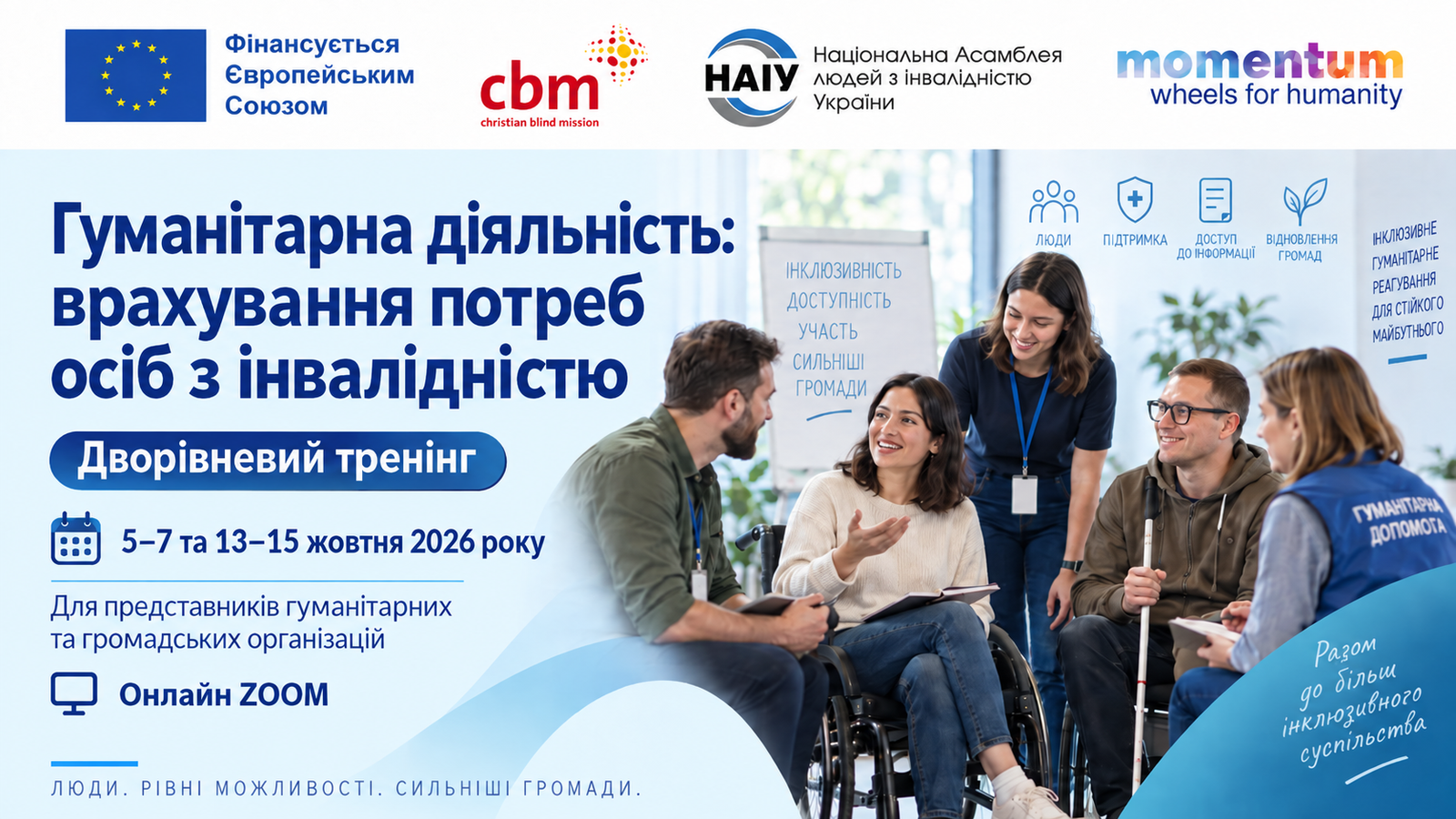
The National Assembly of People with Disabilities of Ukraine (NAPD), in partnership with CBM, is working to equip Ukrainian vocational education and training providers with more practical tools for inclusive education.
As part of the project “Inclusive Vocational Education: Improving Training for Veterans and People with Disabilities,” 100 teachers, vocational training instructors, and administrators from VET providers have already completed a series of training sessions.
During the training, participants explored topics including the inclusive approach, Universal Design for Learning (UDL), reasonable accommodation, psychosocial support, and effective interaction with veterans and persons with disabilities.
The project has also delivered a series of supervision sessions and a Training of Trainers (ToT) programme. This marks an important milestone, as knowledge should translate into everyday practice within VET providers – through internal policies and procedures, teamwork, support for learners, cooperation with employers, and day-to-day decision-making.
From International Experience to Practical Transformation
Inclusive vocational education and training does not begin with broad declarations – it starts with practical action.
• Can a prospective learner easily access and understand information about admission?
• Are the physical premises, learning materials, and communication channels fully accessible?
• Does the teacher know how to adapt learning assignments?
• Is the employer prepared to offer a work placement for a person with a disability?
• Is ongoing support available after the learner completes their studies?
These are the fundamental questions that define genuine inclusion.
For persons with disabilities, including women and men veterans, vocational education and training can become a pathway to employment, independence, and active participation in community life. For VET providers, it is an opportunity to become stronger, more modern, and more responsive to people's needs. For Ukraine, it is an essential part of the country’s recovery in which no one should be left behind.
The project “Inclusive Vocational Education and Training (VET): Improving Training for Veterans and People with Disabilities” is being implemented by the National Assembly of People with Disabilities of Ukraine (NAPD), jointly with Christoffel-Blindenmission Christian Blind Mission e.V. (CBM), with financial support from the European Union, Germany, Poland, Estonia, and Denmark as part of the Skills4Recovery Multi-Donor Initiative, which is implemented by Deutsche Gesellschaft für Internationale Zusammenarbeit (GIZ) GmbH and Solidarity Fund PL (SFPL).