International solidarity that changes humanitarian norms: women with disabilities speak out
December 3, 2025
Share:
At a time when the world is facing new humanitarian crises, and Ukraine is fighting for its integrity and independence amid the full-scale invasion by the Russian Federation, it is women with disabilities who are shaping new standards of response, support, and leadership. One of the events that became not just a discussion platform but a space of solidarity—where women’s voices were central and their experience formed the basis for new humanitarian approaches—was the international webinar “Women with Disabilities in Humanitarian Response.” The event took place within the project “Humanitarian Response and Recovery: Strengthening the Leadership of Organizations of Women with Disabilities,” implemented by the National Assembly of People with Disabilities of Ukraine with technical support from UN Women in Ukraine and funding from the UN Women’s Peace and Humanitarian Fund (WPHF).
The full-scale war has exacerbated all existing forms of discrimination faced by women with disabilities. Beyond physical inaccessibility—complicating evacuation, access to shelters, medical care, and humanitarian services—new risks emerged: being left without support during shelling, the inability to receive information in accessible formats, breaches of privacy and safety in temporary accommodation. Women with disabilities disproportionately experience economic discrimination, lose jobs, and are forced to depend on inadequate social protection systems. Added to this is the higher risk of violence—domestic, institutional, economic—which often remains invisible. And a systemic issue remains: the absence of women with disabilities in decision-making processes that directly affect their lives.
During the war, despite enormous challenges, Ukrainian organizations of women with disabilities have become more visible due to their significant contributions to community development, humanitarian assistance, and new approaches to addressing emerging challenges. The experiences shared by the webinar speakers demonstrate that women with disabilities are not passive recipients of aid but active leaders and practitioners who are often the first to respond to community needs.
For example, the experience of Valentyna Dobridina from Chernivtsi, representing the NGO “Lider,” shows how local initiatives can transform the lives of thousands. Since 2014, her organization has supported people with disabilities, and after 2022, it shifted its work toward assisting internally displaced persons. Ms. Valentyna leads systemic efforts to create inclusive spaces and meet the basic material needs of IDPs. Since the start of the full-scale invasion, more than 4,000 people have received cash assistance, and gynecological wards and inclusive hospital rooms have been established in medical facilities in Chernivtsi. All these examples demonstrate how women’s leadership builds genuine humanitarian capacity. Valentyna Dobridina’s words—“what is accessible for people with disabilities is accessible for everyone”—reflect a core principle of inclusion that, unfortunately, is still far from becoming a norm.
Speaker Binasa Goralija, Regional Coordinator for the EU at MyRight – Empowers People with Disabilities, reminded that her country, Bosnia and Herzegovina, experienced similar hardships during the 1990s war, when people with disabilities remained invisible to the humanitarian system. She emphasized that discrimination against women with disabilities remains widespread in the region—in Bosnia, Kosovo, Montenegro, and beyond. Her reflections on UN Security Council Resolution 2475, which recognizes the protection needs of people affected by armed conflict, and Resolution 1325 on Women, Peace and Security, underscore a key point: these documents remain declarative unless women with disabilities are heard and included in real policy planning. Binasa Goralija stated directly that inclusion is not charity—it is a human rights obligation of states and international institutions.
Caroline Atyem, an advocate for the rights of deaf people, human rights defender, founder and former Executive Director of the South Sudan Women with Disabilities Network, current Executive Director of the African initiative Sound of Silence, and representative of the Global Network of Refugees with Disabilities, spoke about her advocacy for accessible information for people with hearing impairments. Her account of years spent fighting for sign language interpretation in the South Sudan parliament, the lack of accessible information for women with disabilities, and the absence of sign language in key institutions illustrated how crucial the systematic work of organizations of women with disabilities can be—even when governments fail to create conditions for participation. Her words that “it is impossible to have conversations about forming inclusive policies if people with disabilities are not part of these conversations” captured the central logic of the webinar.
Gunta Anča, Vice President of the European Disability Forum, emphasized that today the world sees the destruction caused by bombings in Ukraine but does not see a woman in a wheelchair trying to evacuate from the fifth floor without an elevator or a woman with hearing impairments who has no access to critical information during an air raid alert. Her statement that women with disabilities are agents of change reminds us of something obvious yet often overlooked: their resilience, creativity, and responsibility sustain communities during war and crisis.
Julius Mwenyi Ntubua, representing the Global Network of Refugees with Disabilities, noted that Ukraine has become the first country to raise the issue of participation of people with disabilities in wartime conditions on such a scale, and stressed that the international community must follow this example. His words that the engagement of people with disabilities in Ukraine is both visible and systemic served as important external validation of the path chosen by Ukrainian organizations.
Larysa Baida, Program Director at NAPD, who moderated the discussion, summarized the speakers’ contributions: “Ukraine is now accumulating unique experience that must be integrated into international policies—from humanitarian response to human rights mechanisms. International women leaders need to unite, and joint recommendations should become a high standard for the global humanitarian system.” She emphasized that this was the first in a series of NAPD events that will create opportunities to discuss the protection of the rights of women with disabilities from different countries and their inclusion in humanitarian response.
Women with disabilities must not remain outside the processes that shape their lives. They should be among those who make decisions, define policies, assess impacts, and propose changes. Today, as Ukraine endures difficult times, the voices of women with disabilities—amplified by international partners—can become part of a global movement for rights, safety, and protection.
That is why the international dialogue initiated by NAPD is so important. This is not about exchanging opinions for the sake of formality. It is about creating a space where Ukrainian women leaders can speak directly with colleagues from other countries—about peacebuilding processes, humanitarian standards, and the need to reset approaches that still fail to account for the needs of women with disabilities. It is about ensuring that Ukraine’s experience—painful yet immensely valuable—becomes part of international recommendations and policies.
This webinar demonstrated how mutual learning, knowledge exchange, and cross-country support can strengthen the movement of women with disabilities. Ukraine is currently in the global spotlight, and at the same time, women with disabilities in Ukraine are becoming a voice that changes the rules. Their visibility reflects both individual stories of success and systemic work—a readiness to speak for their communities and an ability to influence humanitarian decisions affecting millions.
The Women’s Peace and Humanitarian Fund (WPHF) is the only global financing mechanism exclusively dedicated to supporting women’s participation in peace and security processes and humanitarian action. Governed by a diverse group of civil society, government, and UN representatives, WPHF is a multi-partner trust fund that mobilizes urgently needed funding for local, women-led organizations and works alongside women on the front lines to build lasting peace. Since 2016, WPHF has provided funding and strengthened the capacities of over 1,000 local women’s civil society organizations advancing the Women, Peace and Security agenda and delivering humanitarian action in 41 crisis-affected countries.
This publication has been prepared with the financial support of the United Nations Women's Peace and Humanitarian Fund (WPHF), which does not imply that the views and contents expressed herein are officially endorsed or recognized by the United Nations."
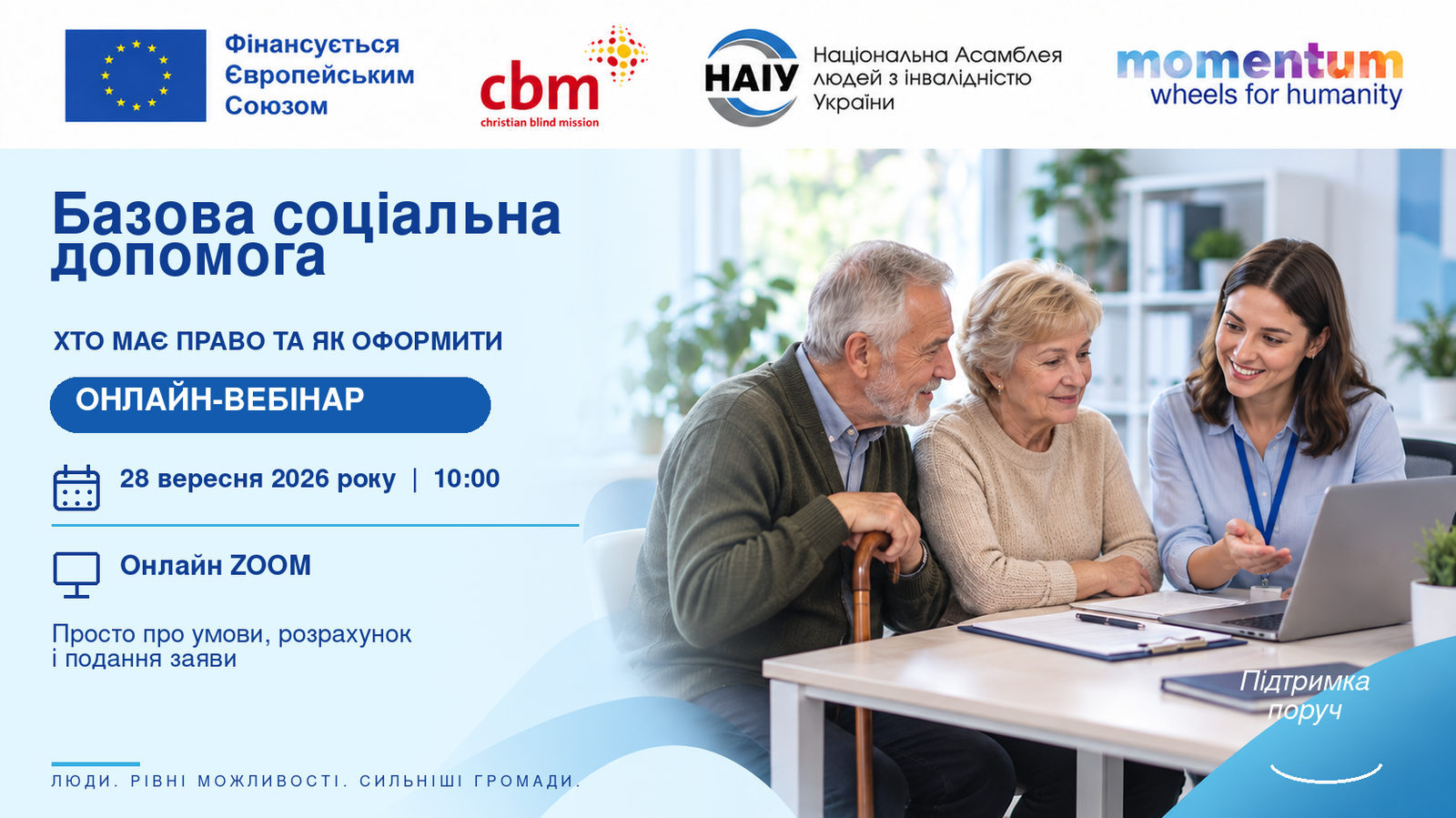
Цей матеріал підготовлено в межах проєкту «Зміцнення інклюзивних послуг з охорони здоров’я, реабілітації та захисту постраждалого від війни населення», який допомагає людям у громадах, що постраждали від війни, отримувати інформацію про доступні послуги та державну підтримку. Цього разу пояснюємо, що таке базова соціальна допомога, від чого залежить її розмір і як подати заяву. Базова соціальна […]
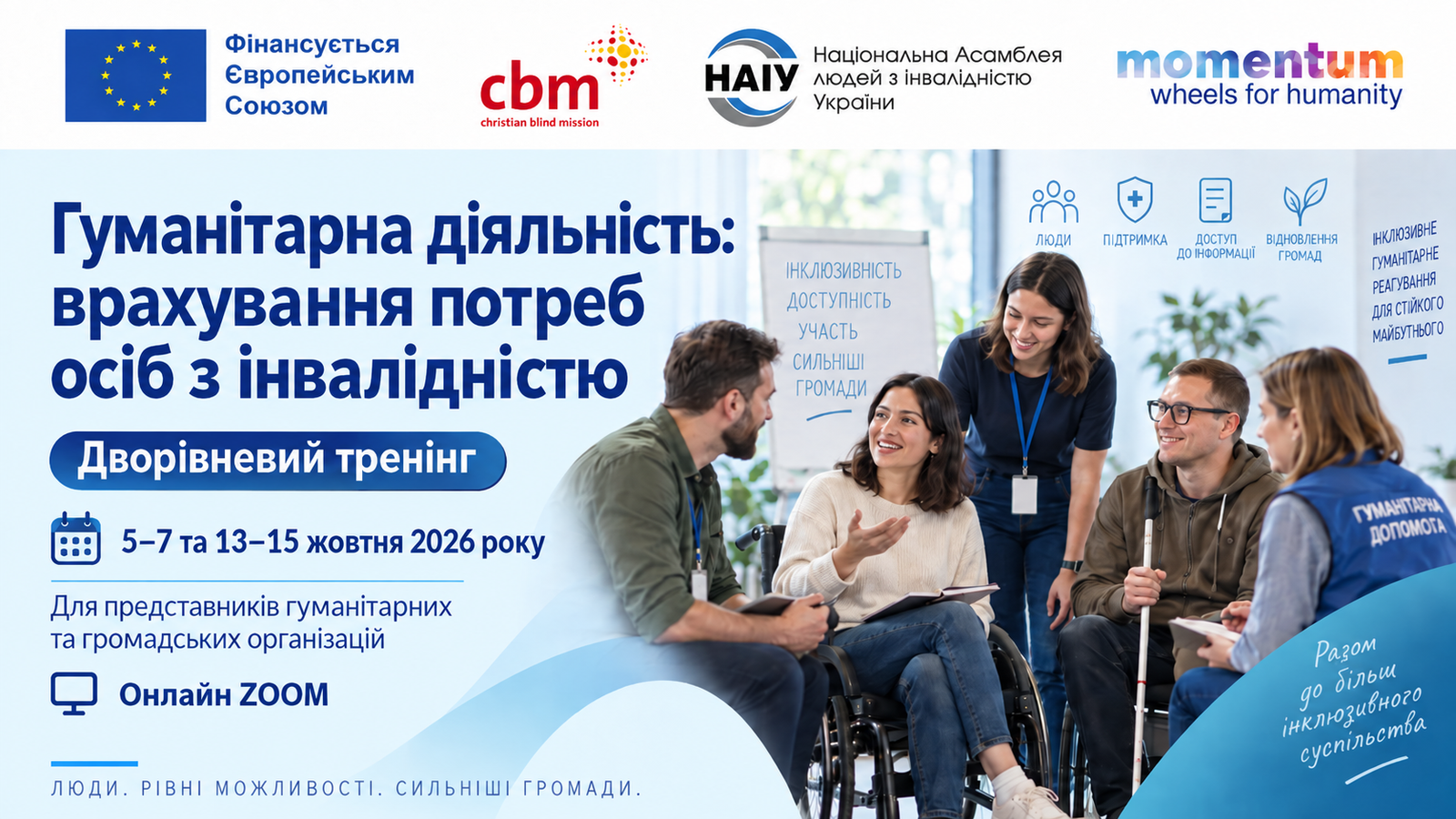
Національна Асамблея людей з інвалідністю України (НАІУ) проводе дворівневий онлайн-тренінг «Гуманітарна діяльність: врахування потреб осіб з інвалідністю». Тренінг відбудеться в межах проєкту «Зміцнення інклюзивних послуг з охорони здоров’я, реабілітації та захисту постраждалого від війни населення», який співфінансується Європейським Союзом та Christian Blind Mission (CBM) і реалізується CBM у партнерстві з Momentum Wheels for Humanity (MWH) […]
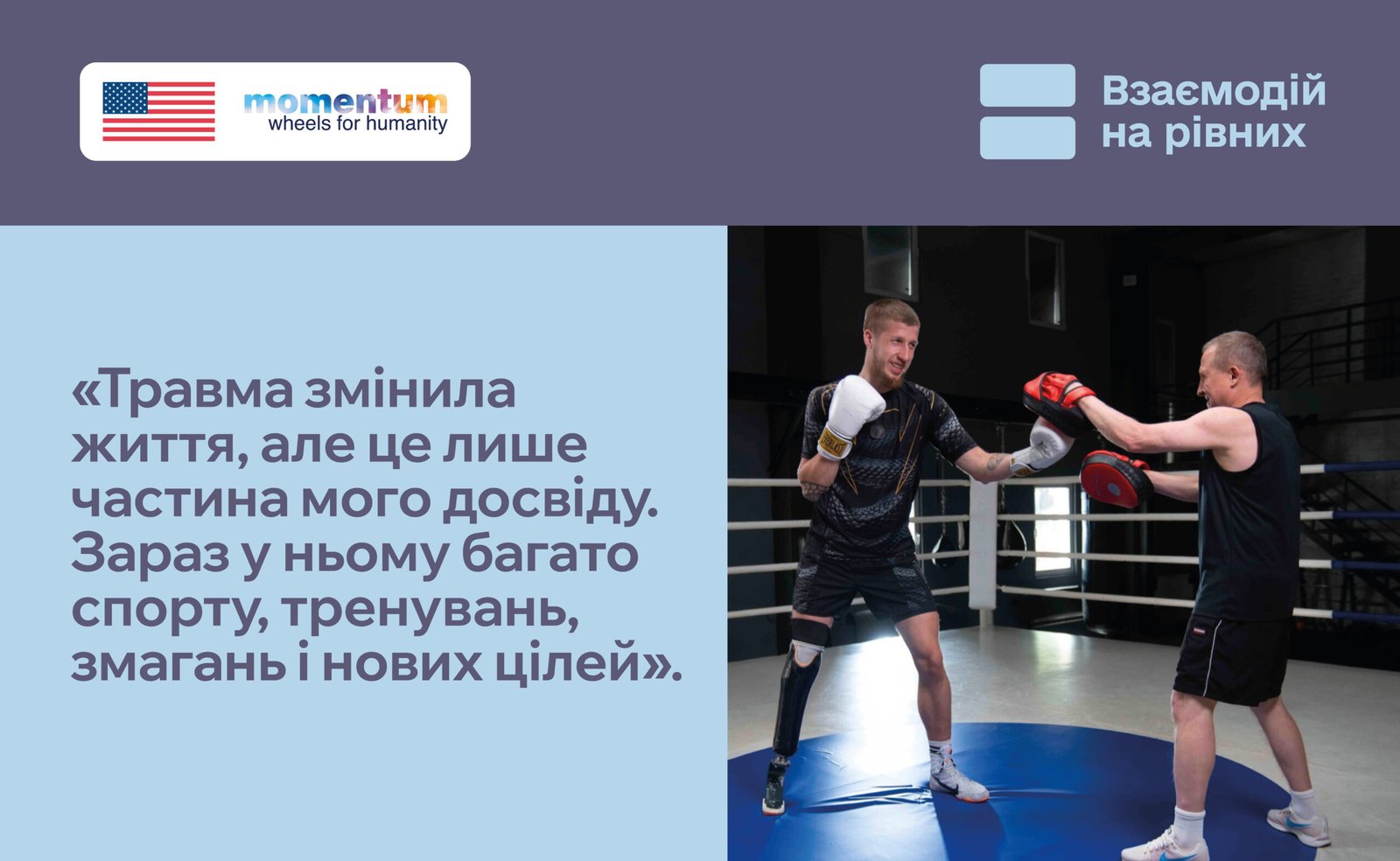
В Україні стартувала інформаційна кампанія «Взаємодій на рівних», спрямована на зменшення стигми, стереотипів та упереджень щодо людей з інвалідністю. Бар’єри для людей з інвалідністю — це не лише сходи без пандуса чи недоступний транспорт. Вони можуть виникати також через те, як ми сприймаємо людину, що про неї припускаємо та як із нею взаємодіємо Наприклад, ми […]
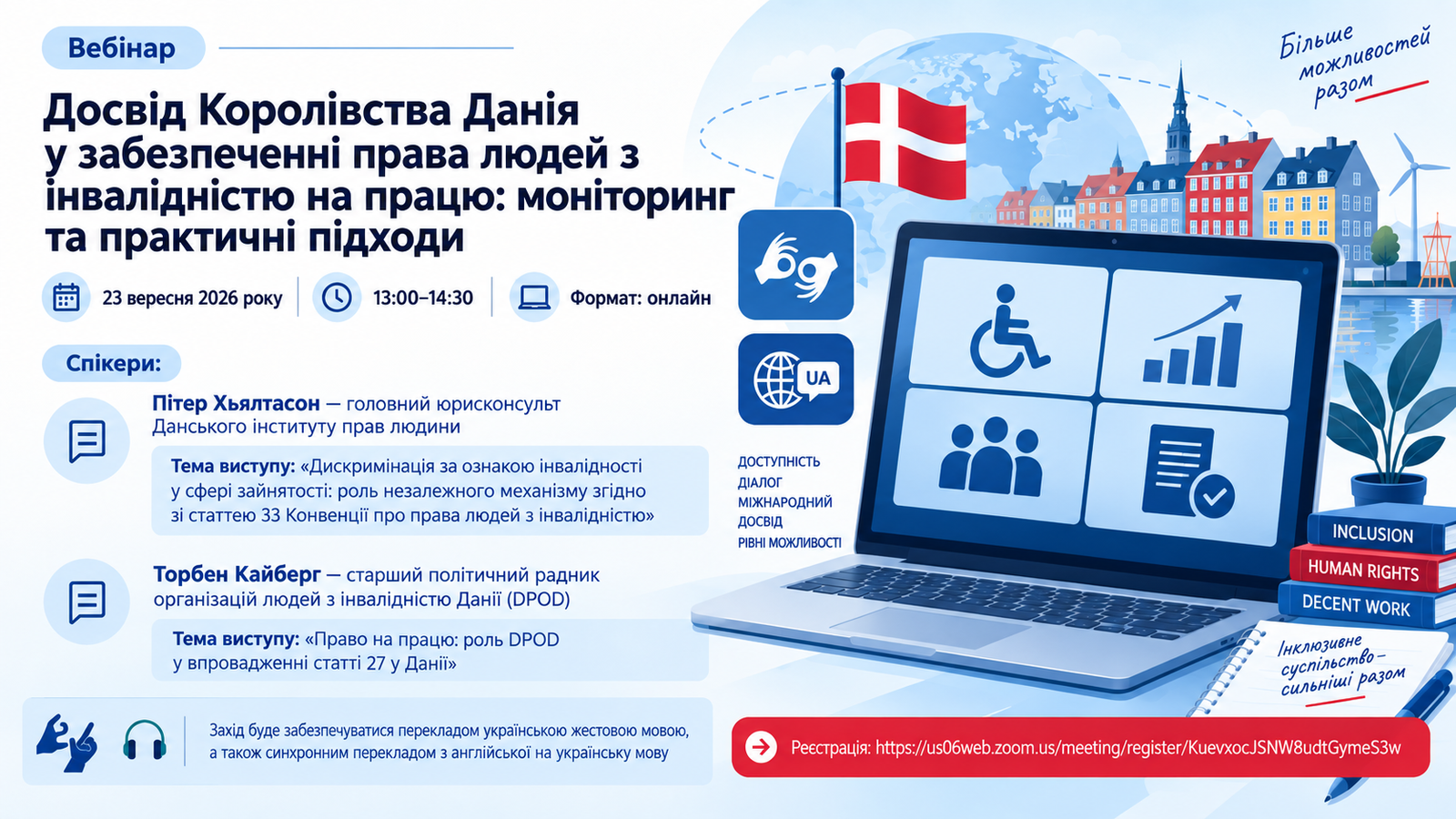
Разом із данськими експертами говоритимемо про: ▪️ протидію дискримінації за ознакою інвалідності у сфері зайнятості;▪️ роль незалежного механізму відповідно до статті 33 Конвенції про права людей з інвалідністю;▪️ досвід DPOD у впровадженні права на працю, передбаченого статтею 27 Конвенції. 🎙 Спікери: Пітер Хьялтасон, Данський інститут прав людини, та Торбен Кайберг, Організації людей з інвалідністю Данії […]
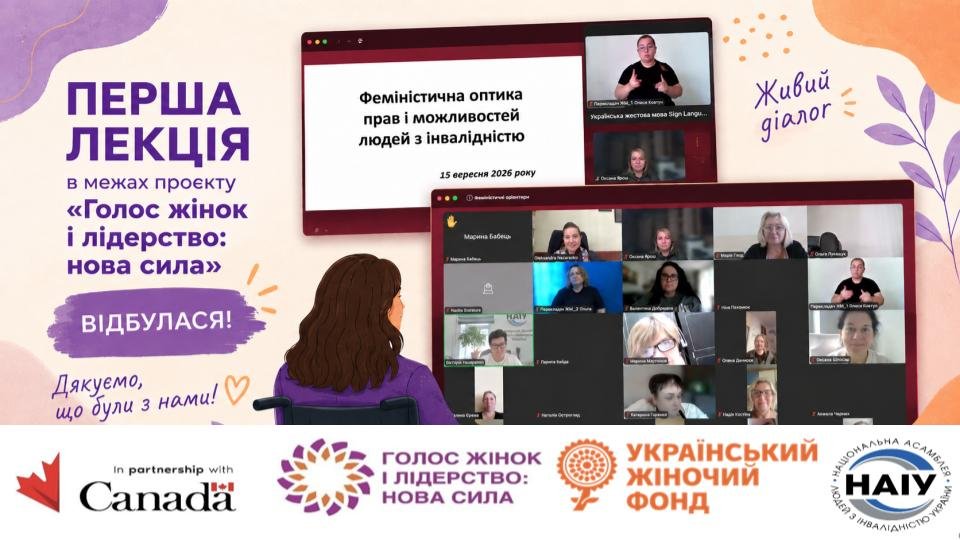
15 вересня в межах проєкту «Голос жінок і лідерство: нова сила» відбулася перша лекція на тему «Феміністична оптика прав і можливостей людей з інвалідністю». Зустріч вийшла справді живою та насиченою. Говорили про права людей з інвалідністю через призму феміністичного та інтерсекційного підходів, про становище жінок з інвалідністю, їхню видимість і представництво, а також про бар’єри, які виникають на […]
During a full-scale war, the financial burden on Ukrainian families has increased significantly. Rising prices for goods and services, unstable incomes, and additional daily expenses are forcing many people to reevaluate their budgets and put off things they thought they couldn’t do without. This situation is particularly difficult for people with ongoing medical expenses.