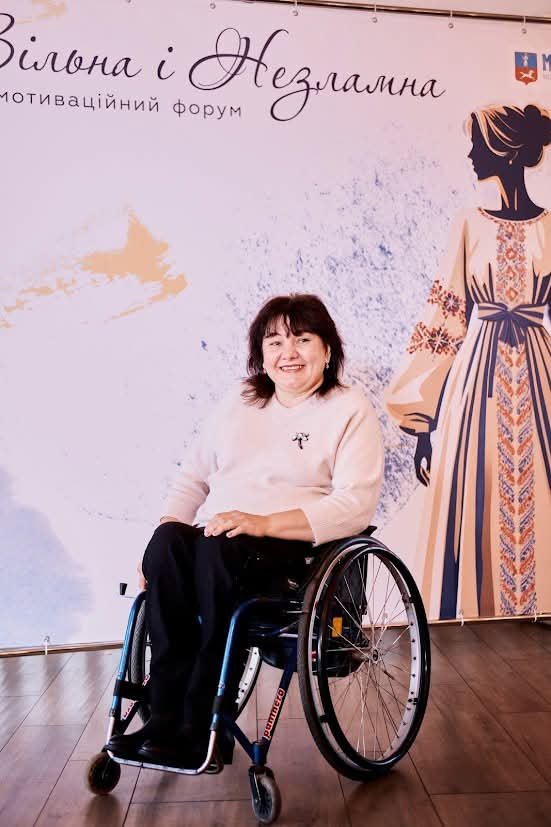
Natalia Kapustian is a representative of the Government Commissioner for the Rights of Persons with Disabilities in the Cherkasy Regional Military Administration, Head of the NGO Kaniv Organization of Persons with Disabilities “Vidrodzhennia”, and works with people with disabilities. She also coordinates the Women’s Health project in the Kaniv community.
Her personal experience of navigating the healthcare system includes a range of situations: positive experiences, when Natalia felt heard by healthcare professionals, as well as cases when decisions about examinations and medical interventions were made without proper discussion with her. At the same time, Natalia also speaks about gradual changes that became possible through dialogue with doctors and other healthcare professionals.
What does a comfortable and safe gynecological appointment mean to you?
For many women, visiting a gynecologist is a routine part of taking care of their health. But for a woman who, like me, uses a wheelchair, it can often become a real challenge, almost an entire quest.
Not every gynecological office is accessible. It is often impossible to enter the premises independently, transfer onto the gynecological examination chair, or undergo the necessary examination.
And it is not only about physical barriers. There is also significant psychological discomfort.
When I started working on the Women’s Health project, I was shown a gynecological office in Kaniv and told that it was fully accessible. But when I entered, looked at the equipment and asked, “How am I supposed to transfer onto this chair?”
Even at its lowest setting, it was still too high for me. Then they showed me a large patient lift with a hammock-like sling, positioned near the window.
The door of the office had a sign saying: “Barrier-Free Gynecological Office.” But I explained that I should be able to enter the office independently, receive the medical service, and leave independently as well. I do not want to be transferred using this device.
I have been using a wheelchair for 36 years, and I know my body and my abilities very well. For me, this is a matter of dignity.
So an accessible gynecological office is not simply about having a ramp or specialized equipment. It is about being able to receive healthcare without fear, shame, humiliation, or dependence on other people.
You were injured at a young age. After acquiring a disability, how did your family talk to you about reproductive health?
I was injured in a road traffic accident in 1990. At the time, I was in the eleventh grade and was 17 years old.
After I acquired a disability, no one in my family ever talked to me about reproductive or sexual health. No one explained that I could fall in love, have a family, or have children. No one told me that I should see a gynecologist and take care of my reproductive and gynecological health.
At that time, sexuality education was rarely discussed either at school or at home. It was considered an uncomfortable, shameful topic. And when a person acquired a disability, it felt as though this entire part of their life was assumed to disappear. As though love, relationships, family, or sexuality were no longer things they were even supposed to think about.
That is why I always say that when a child with a disability is growing up in a family, or when a young person acquires a disability, the entire family needs support. Parents also need psychological support so that they can come to terms with the changes and do not project their own fears onto their child’s life.
A person with a disability does not stop being a woman or a man. They do not lose their right to intimacy, family life, parenthood, or motherhood.
Have you encountered such prejudices in your work with other women?
Yes, and very often they begin within the family itself.
I head a civil society organization and communicate with many women with disabilities. Some of them have been told directly by relatives: “Why do you need a family? You are a person with a disability.”
Women have had to defend their right to a personal life, sometimes against the views of those closest to them. Among the women I work with are young women with disabilities who have started families and are raising two children each. Yet even after that, they still do not receive understanding or support from their parents.
It is especially painful when relatives blame a woman for deciding to have a child, or use the child’s disability as a reason to humiliate the mother.
Such words and actions leave very deep wounds. That is why change must begin not only in hospitals. We also need to change how families and society perceive the lives of people with disabilities.
What was your first experience of seeking gynecological care after the injury?
I developed urological health problems, and as part of the examination, the doctors needed to perform a gynecological examination.
I was still very young at the time. To help me transfer onto the gynecological examination chair, a large number of people were called into the room. They were not all healthcare professionals.
No one asked me whether I consented to all of those people being present. No one explained what was going to happen or what kind of assistance I actually needed.
It was an extremely difficult experience for me. I felt deeply humiliated.
The fear from that experience stayed with me for many years.
How did that experience affect your future interactions with doctors?
Later, when I developed serious gynecological health problems, I remembered that previous experience very clearly.
By then I was older and better able to advocate for myself. I said categorically that I would not go to the city hospital. We went straight to a regional healthcare facility. I hoped it would be better and more accessible there.
But that department also had a number of accessibility barriers.
I could not access the bathroom because the doorway was too narrow for my wheelchair. Before surgery, I needed to complete the necessary preparations, but I could not do so in the bathroom.
Everything had to be done in the hospital room with my husband’s help. It was fortunate that we were there together, but even under those circumstances, it was an unpleasant experience. The nurses also did not always understand how to assist me. They had no experience of working with patients with needs like mine.
What changed after the surgery?
The surgery was successful. And the most valuable change happened afterwards.
We began talking more with the doctors and other healthcare professionals. Gradually, genuine human connection developed between us.
They began to see me not only as a person with a disability whom they did not know how to examine or treat. First and foremost, they saw me as a woman and as a person.
We talked about respect, accessibility and dignity. We discussed which of their actions at the beginning had felt humiliating to me and what could have been done differently.
I am still in touch with the doctor who performed my surgery. When we meet, we can simply talk as good friends.
Staff members in the department later told me that after my treatment they had gained a better understanding of how to interact with women with disabilities. They had not had many patients with disabilities, but they remembered that experience.
For me, it is very important that their understanding changed.
They came to see that a woman does not stop being a woman after acquiring a disability. Above all, you need to see the person.
Do you ever have to explain aspects of your body to healthcare professionals that they should take into account?
Yes. For example, not all healthcare professionals understand what spasticity is or how it can manifest.
I recently underwent an examination. I needed to lie on a hard surface for imaging. The healthcare professionals saw that because of spasticity my body could not assume the position they needed, and they became concerned that they would not be able to carry out the examination.
When a person with a spinal cord injury lies or sits on a hard surface, their muscles may involuntarily become very tense. My spasticity does not occur all the time, but a hard surface can trigger it.
The healthcare professionals tried to force my legs into the position required for the procedure. I did not feel pain, but I understood that this was not the right thing to do. I asked them to wait for a minute so that my body could relax.
A spastic movement can be very strong. A person cannot control it through willpower. A healthcare professional who does not understand this may injure the patient or themselves
That is precisely why medical equipment must accommodate different needs. An examination couch should be height-adjustable, have a sufficiently soft surface, and be suitable not only for the examination itself but also for allowing a woman to undress and dress safely.
At our city hospital, I was shown equipment purchased with international funding and told that everything was now accessible. But the ordinary old examination couch remained unchanged: hard, high and non-adjustable.
It is difficult for me even to bend down, put on my shoes or get dressed on it, particularly if spasticity occurs.
People at the local level may genuinely want to create accessible conditions, but they do not always understand exactly what is needed. That is why it is important to consult the people who will actually use the services and equipment.
Can a nurse or assistant be present during an appointment?
Additional assistance is sometimes genuinely necessary. But this must be discussed with the woman.
You cannot simply invite several people into the room without explaining who they are, why their presence is necessary, and what exactly they will be doing.
The patient must have the right to agree or refuse. She can also explain what kind of assistance she actually needs and what would only cause additional discomfort.
A doctor may be thinking about what would make the examination easier for them. But it is equally important to ask what will be safe and comfortable for the woman.
After these experiences, did you start seeing a gynecologist less often?
Yes. To be honest, I very rarely visit a gynecologist.
I do not have sensation in the lower part of my body, so I face additional risks: I may not notice certain symptoms or changes. That is precisely why regular examinations are particularly important for me.
But I still do not feel ready to undergo such an examination at the Kaniv hospital. I hope that thanks to the project, the office will become genuinely accessible and the situation will change.
To see a doctor in Cherkasy, I have to travel a considerable distance. Such a visit requires planning, time, transportation and appropriate hygiene facilities. It is not a situation where you can simply leave home and be in the doctor’s office a few minutes later.
When I was recently at the regional hospital with my husband, I took the opportunity to see the doctor who had operated on me years ago. We have known each other for a long time, so I felt calm during the appointment. There were no unnecessary questions or tension.
But that relationship had been built over many years. I cannot recall a situation in which I visited a new gynecologist for the first time and immediately felt that the healthcare professional knew how to interact with me and that I did not have to explain anything extra.
Overall, I have had very few such appointments in my life.
Why do women with disabilities postpone medical examinations?
There can be many reasons: fear, shame, previous traumatic experiences, inaccessible healthcare facilities, or the lack of appropriate equipment or transportation.
Sometimes a woman does not know whether she will be able to enter the examination room, whether there will be an accessible bathroom, who will assist her during the examination, or whether her privacy will be respected.
Even when the doctor is in another city, the entire journey has to be planned. Where can she use a bathroom? Will she be able to maintain personal hygiene? Will she be able to transfer independently? Will she have to ask strangers for help?
Any one of these barriers can become a reason to postpone the visit.
I very much want women not to give up medical examinations because of fear, shame or the inaccessibility of a healthcare facility. It is their health, and they have the right to receive the care they need.
But we cannot simply tell women to visit doctors more often. First, the system must create conditions that genuinely enable them to do so.
Does the healthcare system take the needs of women with disabilities into account?
It would not be accurate to say that women with disabilities are entirely outside the healthcare system. But their experiences often remain invisible.
When I spoke with staff members in the department, they told me that after my treatment they had seen almost no patients who use wheelchairs or have visible disabilities
But that may also mean that women simply do not seek care.
Disability is not always visible. There may have been women with other types of disabilities in the department, but healthcare professionals may not have known about their disabilities or taken their needs into account.
If women do not attend preventive health check-ups, it does not mean that they do not need healthcare. Often, it is a sign that accessing that care is simply too difficult.
What changes do you hope to achieve in your community through the Women’s Health project?
I am very grateful to the National Assembly of People with Disabilities of Ukraine for inviting me to take part in this project. I believe it can lead to important practical results.
I want every girl or woman with a disability who enters our outpatient clinic or hospital to feel confident, calm and safe.
I want her to know that the facility is not merely ready to accommodate her needs, but that accessibility has already been considered before she arrives.
I want to see a gynecological office with wide doors and enough space to manoeuvre a wheelchair. There should be an accessible bathroom nearby. The examination couch and gynecological examination chair should be adjustable and accommodate the needs of different women. All necessary examinations should be accessible within a single patient pathway.
I want healthcare professionals not only to be highly qualified specialists but also to understand how to communicate with and provide care to women with different types of disabilities. They should respect their dignity, privacy and right to make their own decisions.
For me, the main outcome of the project should not be only renovated premises or newly purchased equipment.
I want attitudes towards girls and women with disabilities to change, together with the conditions in which they receive healthcare. I want them to be able to access services on an equal basis with other women and to enjoy equal rights.
Oleksandra Perkova, Communications Manager of the Project