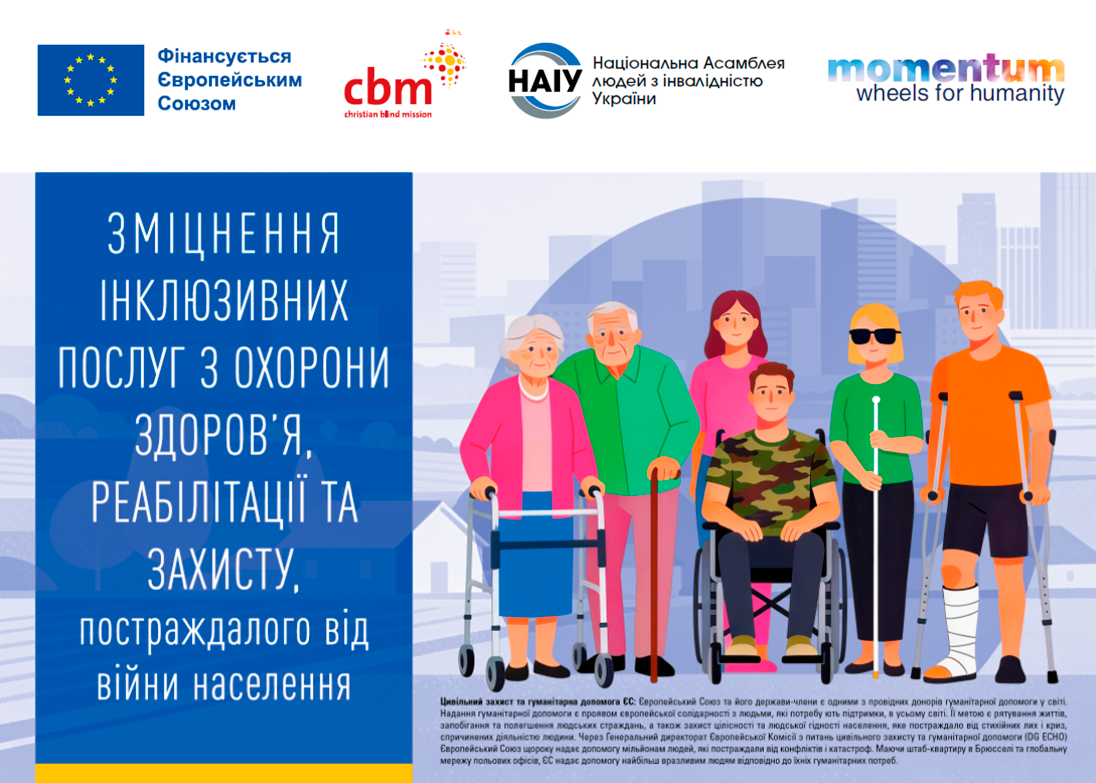
The National Assembly of People with Disabilities of Ukraine (NAPD) has joined a new humanitarian project aimed at improving access to healthcare, rehabilitation, and protection services for people with disabilities and other vulnerable groups within their communities.
The project is funded by the European Union through the Directorate-General for European Civil Protection and Humanitarian Aid Operations, which is providing €2 million in humanitarian aid. The project is also co-funded by Christian Blind Mission e.V. (CBM).
Implementation will run from May 2026 to April 2027. More than 15,000 war-affected individuals across the Chernihiv, Sumy, Kharkiv, and Poltava regions are expected to benefit from the support.
The project is being implemented by CBM in partnership with Momentum Wheels for Humanity and the National Assembly of People with Disabilities of Ukraine (NAPD).
For the NAPD, this project builds on its systematic work in the field of inclusive humanitarian response. At its core is not simply the provision of assistance, but the identification of solutions that genuinely work within communities – ensuring that people know where to seek help, can access the services they need, and receive clear information, guidance, and ongoing support.
The project covers 8 communities across four regions of Ukraine:
Chernihiv region: Bobrovytsia and Kozelets communities
Kharkiv region: Merefa and Pisochyn communities
Poltava region: Machukhy and Semenivka communities
Sumy region: Lebedyn and Trostianets communities
The project focuses on people who often face multiple barriers simultaneously, including disability, older age, the impacts of war, difficult life circumstances, and limited access to transportation, services, information, or legal assistance.
“It is important to us that community-level support is not merely formal, but genuinely works for people. We will take a comprehensive approach to addressing people's needs by examining what prevents them from accessing assistance, what barriers exist at the local level, and how these barriers can be reduced in collaboration with communities,” says Svitlana Petrusha, NAPD Project Coordinator.
Through this initiative, people affected by the war will be able to access healthcare, rehabilitation, and protection services closer to their homes. The project also provides access to assistive devices, psychosocial support, legal assistance, and clear information regarding available services and rights.
Another important area of work is strengthening local services. This includes improving accessibility, providing essential equipment, offering technical support, and building the capacity of healthcare, rehabilitation, and social sector professionals. This approach helps not only respond to individual needs but also to gradually raise the quality of services within communities.
NAPD’s previous work demonstrates that effective support begins with simple yet essential steps: listening to the individual, mapping their pathway to services, identifying exactly where barriers arise, and engaging local authorities, civil society organisations, and service providers to find solutions.
These barriers may take the form of an inaccessible building, a complicated procedure, a lack of transportation, insufficient information, or simply a situation where someone does not know where to turn for help. In every case, it is essential that the person is not left to face these challenges alone.
“When we work with communities, it is important not just to ask what assistance is needed today. We also need to understand what might prevent a person from receiving that assistance tomorrow – whether it is transportation, a lack of information, inaccessible premises, complicated procedures, or a lack of support. These are the barriers we must identify and systematically remove,” emphasizes Svitlana Petrusha.
Particular attention within the project will be given to people with disabilities, who often face additional barriers when accessing humanitarian assistance and public services. This is not just about physical accessibility. It is also about providing information in accessible formats, ensuring that procedures are clear and easy to navigate, respecting people’s dignity, and upholding their right to participate fully in community life.
For NAPD, the principle of “Nothing About Us Without Us” remains fundamental. Decisions affecting people with disabilities must be made with their direct participation. This is both a time-tested cornerstone of the disability rights movement and a practical mechanism for making better decisions within communities.
It is precisely this approach that helps us transition from isolated services to systemic change: a model where support becomes closer to people, communities become more responsive to the needs of their residents, and people with disabilities become more actively involved in the processes that shape their lives.
For reference.
About EU Civil Protection and Humanitarian Aid
The European Union and its Member States are among the world’s leading donors of humanitarian aid. Relief assistance is an expression of European solidarity with people in need all around the world. It aims to save lives, prevent and alleviate human suffering, and safeguard the integrity and human dignity of populations affected by disasters and human-induced crises. Through the Directorate-General for European Civil Protection and Humanitarian Aid Operations of the European Commission, the European Union helps millions of victims of conflict and disasters every year. With headquarters in Brussels and a global network of field offices, the EU provides assistance to the most vulnerable people on the basis of humanitarian needs.
Through the European Commission’s Directorate-General for European Civil Protection and Humanitarian Aid Operations (DG ECHO), the European Union provides assistance each year to millions of people affected by conflicts and disasters. With its headquarters in Brussels and a global network of field offices, the EU delivers humanitarian aid to the most vulnerable populations based on humanitarian needs.
About CBM
Christian Blind Mission (CBM) is an international development and humanitarian organisation committed to improving the quality of life of persons with disabilities and other vulnerable populations. CBM works with local partners worldwide to promote inclusion, accessibility and equal opportunities in humanitarian and development contexts.
Since the full-scale invasion of Ukraine in 2022, CBM has been supporting humanitarian action and recovery efforts in partnership with national and local organisations, with a particular focus on disability inclusion, rehabilitation, health and protection.
Visit: Ukraine: CBM’s Inclusive Humanitarian Response | startpage
About Momentum Wheels for Humanity
Momentum Wheels for Humanity (MWH) is an international nonprofit dedicated to expanding access to rehabilitation services and assistive products for people with disabilities worldwide.
Since 1996, Momentum Wheels for Humanity has worked in more than 70 countries to strengthen health systems, increase access to high-quality assistive technology, and promote greater inclusion. Our work focuses on three core areas: assistive technology supply and provision, rehabilitation systems strengthening, and inclusive disaster response.
Momentum Wheels for Humanity has worked in Ukraine for more than 25 years. Since Russia’s full-scale invasion in 2022, Momentum Wheels for Humanity has expanded its efforts to strengthen rehabilitation services, train healthcare professionals, improve access to assistive products, and support Ukraine’s long-term recovery and health system development.
Visit: Global Rehabilitation & Assistive Technology Access | MWH