Communities for All: Storozhynets Community Prepares an Advocacy Campaign for Accessible Healthcare
February 17, 2026
Share:
In the Storozhynets community of Chernivtsi region, preparations are underway to implement the advocacy campaign “Communities for All: Creating Change Together with People with Disabilities.” The initiative is being carried out within the framework of the project “Multi-sectoral Disability-Inclusive Humanitarian Assistance for IDPs, Returnees, Veterans, and Host Communities in Ukraine,” implemented by the National Assembly of People with Disabilities of Ukraine in partnership with the European Disability Forum (EDF), with the support of the Federal Foreign Office of Germany (GFFO) and CBM (Christian Blind Mission).
The campaign is being implemented by the National Assembly of People with Disabilities of Ukraine and the NGO “Chernivtsi Regional Organization of People with Disabilities ‘Leader’” in cooperation with the Municipal Non-Commercial Enterprise “Storozhynets Multidisciplinary Intensive Care Hospital” and the Storozhynets City Council. The regional coordinator of the initiative, Valentyna Dobrydina, explains that the campaign’s focus on healthcare is natural, as it is one of the most critical areas of accessibility.
According to Valentyna, all advocacy campaigns in the community share a common logic — they concern the accessibility of services in various sectors for people with reduced mobility.
“The healthcare sector is one of the most important priority areas because residents of the community, including people with reduced mobility, very often turn to medical institutions — for examinations, diagnostics, treatment, and consultations,” she explains.
In previous years, thanks to projects and advocacy efforts, the community has already achieved improvements in the physical accessibility of the hospital: ramps have been installed, the surrounding area has been improved, and other elements of a barrier-free environment have been introduced.
However, as the coordinator notes, after these steps another systemic problem became evident — the inaccessibility of medical and diagnostic equipment. And this is not only about comfort, but also about patient safety.
The hospital still uses equipment that does not take into account the needs of people who use wheelchairs or have other musculoskeletal impairments: rigid, non-functional examination tables, inaccessible urological chairs, lack of scales for weighing people who cannot stand, outdated or unsuitable diagnostic equipment. As a result, undergoing examinations becomes difficult or humiliating, and sometimes even dangerous.
“There are often no staff members who know how to properly assist a person with a disability in transferring from a wheelchair to an examination table. Sometimes people are lifted by their arms or legs — and this can cause injury,” says Valentyna Dobrydina.
Hard surfaces without proper adaptation create risks of skin damage and pressure sores, which can have serious health consequences.
As a result, some people refuse examinations or are forced to travel to other communities, creating additional financial, physical, and psychological barriers.
The problem significantly affects the community: at least 1,600 persons with disabilities live in the area. Nearly 200 of them are persons with Group I disabilities, and 354 are children with disabilities. Additionally, more than 17,000 elderly people reside in the community. All these population groups regularly use medical services and require accessible equipment.
The initiative aims to ensure equal access for people with disabilities to medical and diagnostic services, promote the introduction of universal medical equipment, and involve people with disabilities in healthcare decision-making processes.
The campaign includes several interconnected steps. These include a public dialogue and a flash mob. In the near future, a meeting with the hospital’s management is being prepared with the participation of civil society and veterans’ organizations, as well as community residents. A public event is also planned to draw attention to the issue of accessibility of medical services.
The second step will be an accessibility audit of equipment. In one of the hospital departments, an assessment will be conducted with the involvement of people with disabilities and experts. An accessibility questionnaire will be completed, and recommendations for removing barriers will be prepared.
A roundtable discussion will also be held as a concluding meeting, where the audit results will be presented and joint solutions developed together with the hospital management and local authorities.
Further steps will include implementing the developed solutions in practice.
All these activities will be accompanied by a strong local information campaign. Coordinators will inform the public about the progress and results of the initiative through social media and local media outlets.
The organizers aim to initiate systemic changes in the quality of service provision in hospitals. At the same time, Valentyna Dobrydina emphasizes that the advocacy campaign lasts only the first quarter of the year, while budget processes require time.
“We hope for the allocation of funds and understand that changes require participation and time,” she clarifies.
The advocacy campaign in the Storozhynets community is an example of how accessibility goes beyond ramps and elevators. It is about the right of every person — regardless of mobility — to receive safe, high-quality, and dignified medical care within their own community.
Oleksandra Perkova, Communications Manager of the Project
У 2026 році ветерани війни та інші визначені законодавством категорії громадян мають отримати разову грошову виплату до Дня Незалежності України. Більшості одержувачів гроші нарахують автоматично. Якщо людина набула відповідного статусу до 24 серпня, але станом на 1 жовтня виплату не отримала, вона може звернутися із заявою до Пенсійного фонду України. Повний перелік категорій, які мають […]
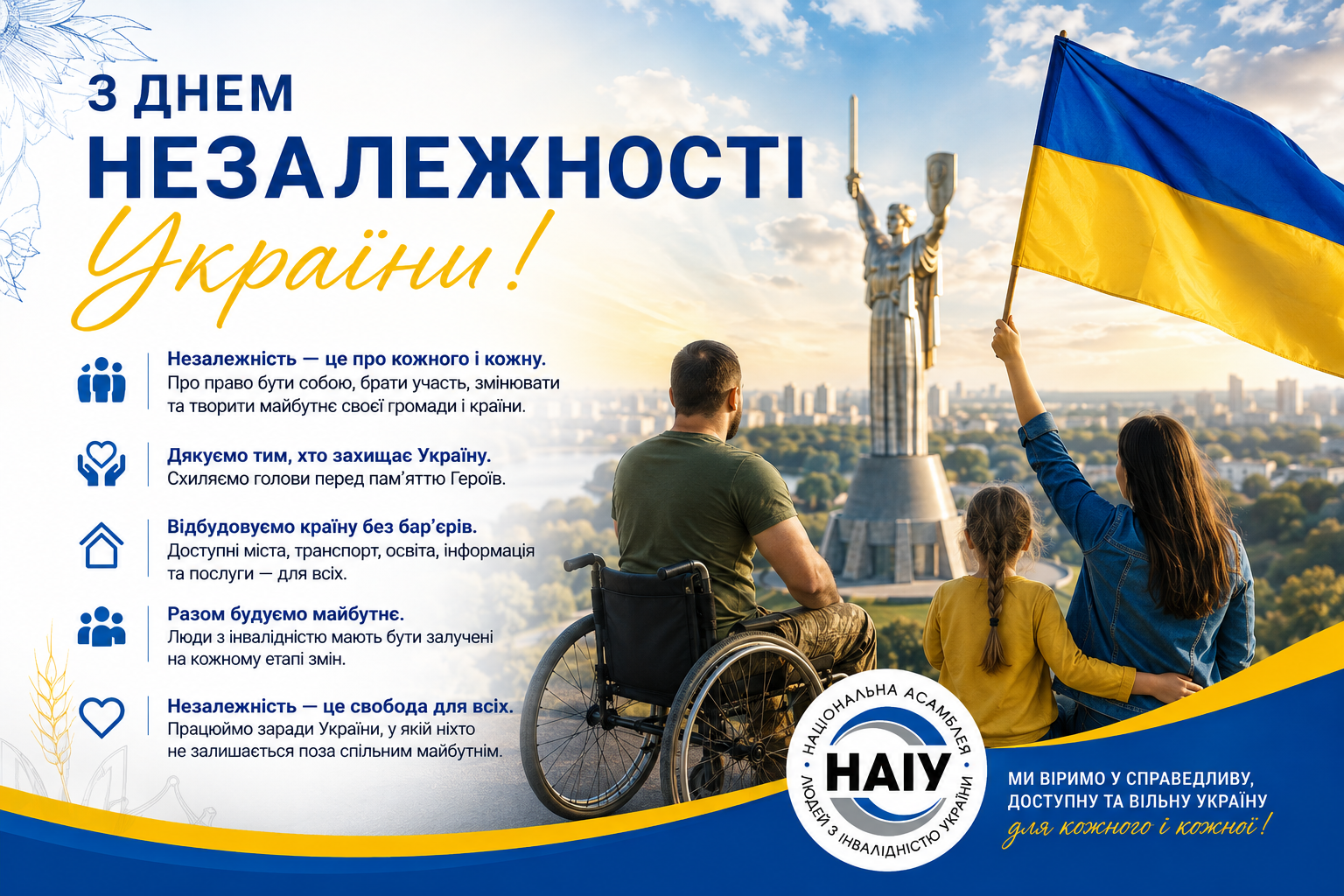
Дорогі друзі! Сьогодні Україна відзначає День Незалежності — свято, значення якого ми особливо гостро усвідомлюємо в час боротьби за свободу, суверенітет і право самостійно визначати своє майбутнє. Незалежність держави має людський вимір. Вона стає реальною тоді, коли кожен і кожна можуть самостійно визначати свій шлях, бути почутими, брати участь у житті громади, навчатися, працювати, подорожувати […]
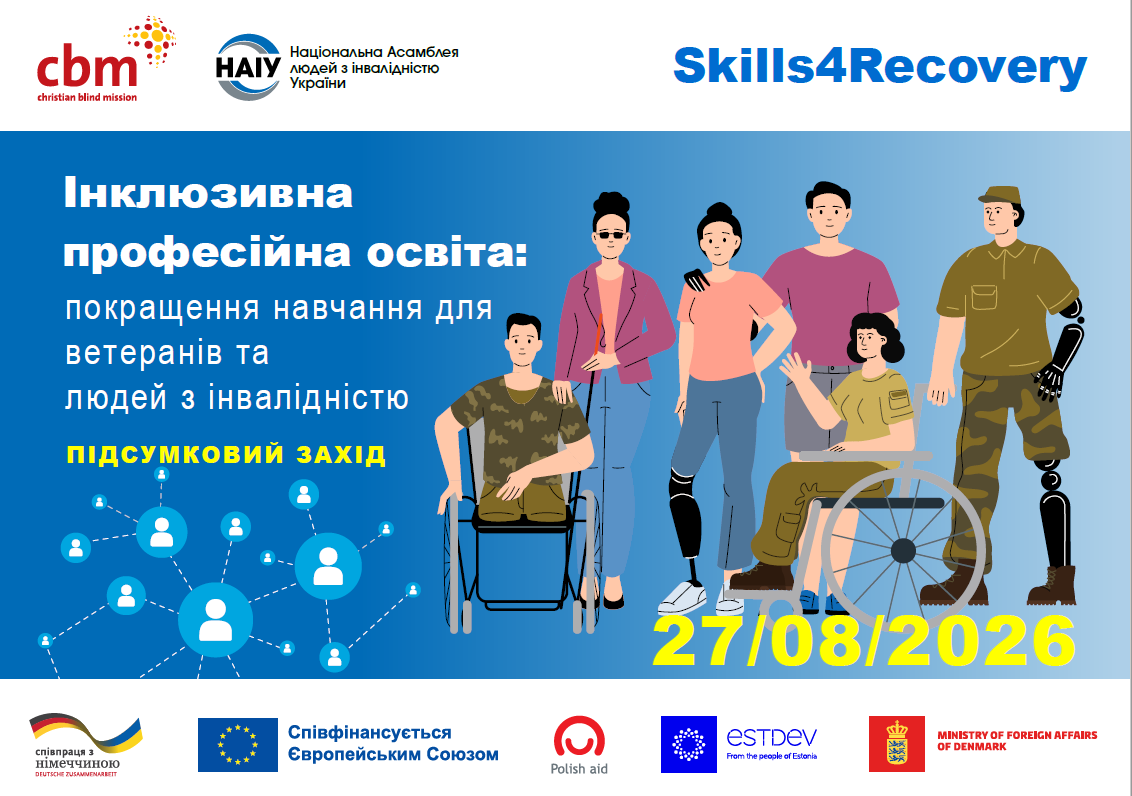
27 серпня 2026 року Національна Асамблея людей з інвалідністю України запрошує представників закладів професійної освіти, партнерів та всіх, хто працює над розвитком інклюзивного навчання, долучитися до підсумкового заходу проєкту «Інклюзивна професійна освіта: покращення навчання для ветеранів та людей з інвалідністю». Захід стане майданчиком для підбиття підсумків проєкту, обміну практичним досвідом та обговорення рішень, які допомагають […]
Кабінет Міністрів України затвердив Положення про супервізію для фахівців у сфері психічного здоров’я. Документ визначає, як має відбуватися така професійна підтримка та хто може бути супервізором. Ознайомитися з документом можна за посиланням. Супервізія допомагає фахівцям аналізувати свою роботу, долати професійні труднощі, дотримуватися етичних норм і стандартів, удосконалювати професійні навички та запобігати вигоранню, а також передбачає […]
У Києві розвивають єдину систему підтримки ментального здоров’я, яка об’єднує можливості закладів охорони здоров’я, освіти, соціальних служб та інших установ. Важливо, щоб для людини ця система не перетворювалася на набір розрізнених послуг, між якими потрібно самостійно шукати шлях. На цьому наголосила заступниця голови КМДА з питань здійснення самоврядних повноважень Марина Хонда на своїй сторінці у […]
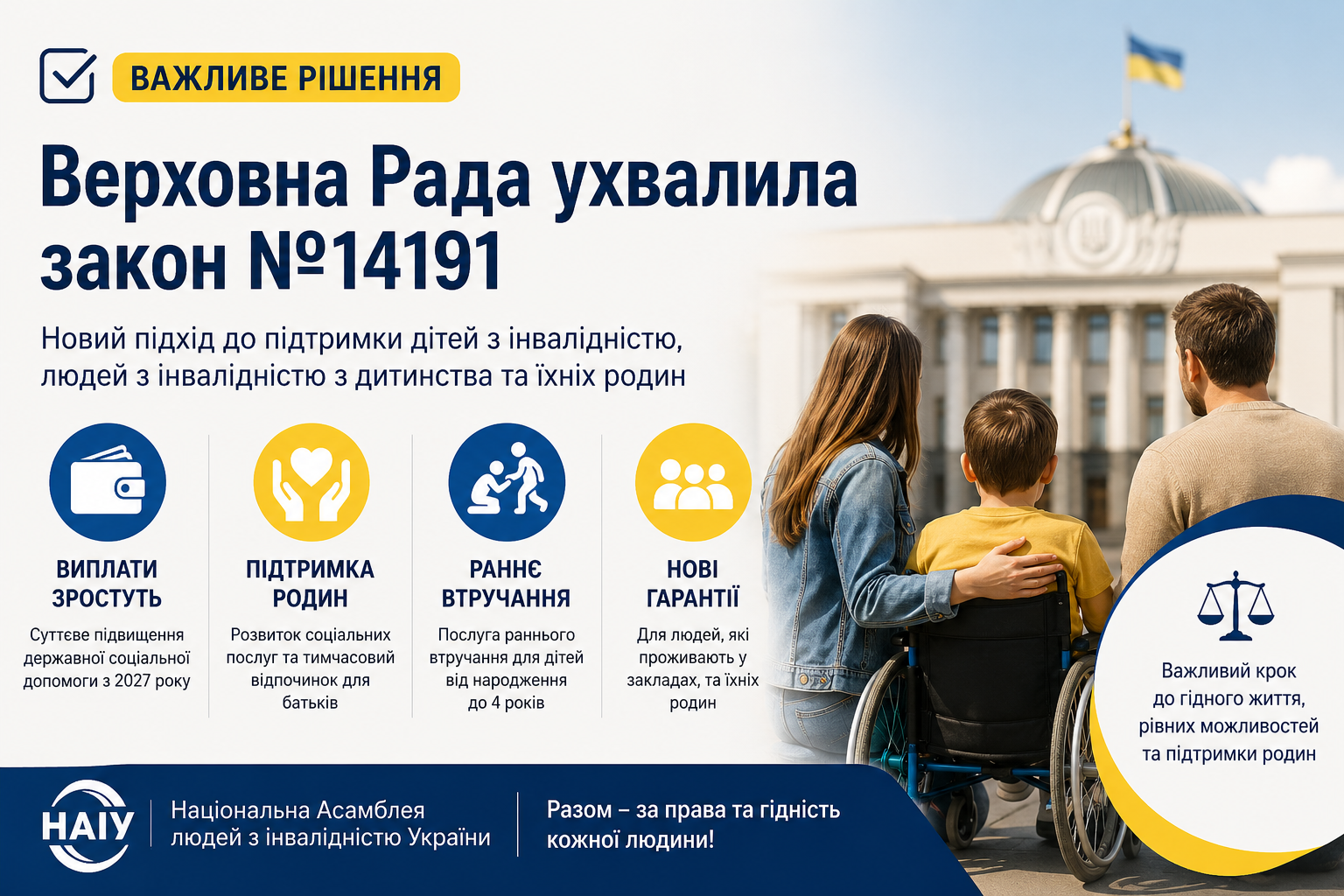
19 серпня Верховна Рада України ухвалила в цілому закон № 14191, який змінює систему державної підтримки дітей з інвалідністю, людей з інвалідністю з дитинства та їхніх родин. Для Національної Асамблеї людей з інвалідністю України це рішення має особливе значення. Робота над законопроєктом тривала більше піврокуі на різних її етапах документ містив норми, які могли призвести […]