Strong, Vulnerable, Unbreakable: The Challenges of War Through the Eyes of Ukrainian Women (ENG)
February 12, 2025
Share:
The full-scale war has brought enormous social challenges to Ukraine. Women have found themselves in extremely difficult circumstances: raising children on their own, caring for relatives with disabilities, working, volunteering, adapting to life in new communities, or undergoing medical and psychological rehabilitation after captivity. In addition to this, they face a difficult economic situation, lack of social support and psychological challenges.
Women with disabilities have faced even more difficult conditions during the war. Evacuation is often almost impossible for them due to the lack of accessible transportation and proper support. Those who stayed in the insecure regions faced a lack of medicines, rehabilitation services and basic accessibility. In communities where women with disabilities have evacuated, there are not always conditions for their full integration - there is a lack of barrier-free housing, employment, and social support. At the same time, they often remain invisible to society, facing double discrimination - both on the basis of gender and physical disability. To improve their situation, it is necessary to develop accessibility in communities, introduce special social support programs, and change public attitudes so that women with disabilities have equal opportunities for life, work, and development.
For mothers raising children with disabilities, the war has also created many difficulties. The fighting has made it difficult to access social services. As many rehabilitation centers are closed or relocated, specialists have moved abroad, and communities cannot provide the necessary support. If there are no daycare services or community support, the mother is left with no support and must care for her child around the clock, without the opportunity to work or have personal time. Rising prices for medicines, special care products, and financial instability, often caused by the loss of a job or housing, make life much more difficult for mothers raising a child with a disability. Women in such situations may also show signs of emotional burnout, depression, and constant fatigue.
To overcome these problems, it is important to develop inclusive services in communities, such as day care centers for children with disabilities, services, and parental support programs. Financial assistance and accessible psychological support for mothers also play an important role.
Women whose husbands are currently at war bear a double burden: they work, raise children, manage the household and often volunteer. In such circumstances, a woman has to take care of children, work, and do household chores at the same time without additional support. And all this is against the backdrop of constant psychological stress - constant worry about her husband's life, information pressure and anxious expectations. Often, a woman's income is not enough to meet the basic needs of her and her child. Communities often lack local support and assistance programs for military women.
Programs to support military families, such as psychological assistance, social initiatives, and financial support, would bring significant improvements to women in this situation. Flexible working conditions created by employers for women who are raising children on their own while their husbands are at the front. Volunteer initiatives to help include childcare and social support hubs.
In times of war, women soldiers and civilians are at risk of being captured by the aggressor country. Those released from captivity often face difficulties upon their return. Torture, abuse, lack of water and food leave a deep mark. Unfortunately, there are not enough centers in Ukraine that specialize in supporting those released from captivity. In addition, there is a stereotype that part of society perceives these women as victims, which increases their isolation and harms their adaptation after captivity. Also, after captivity, our citizens face problems with employment and labor activity. After all, there are cases when employers do not want to pay attention to the invisible struggle that is happening to their employees and choose to turn a blind eye to the consequences of trauma, depression or post-traumatic stress disorder in their employees.
To overcome these problems, comprehensive rehabilitation centers for Ukrainian citizens released from captivity are important, as well as information campaigns for society to overcome the stigma of captivity. NGOs and the state should also implement psychological, legal, and medical support programs.
Women with the status of internally displaced persons also face challenges on a daily basis. They have to deal with the loss of their homes and the search for new housing, as government programs do not always cover their needs, and rent is expensive. It is difficult to look for a job in both rural and urban areas, as there are often few vacancies in the former, and high competition among job seekers in cities. In some cases, unfortunately, women feel pressure from the new community, as local residents do not always perceive IDPs as friendly. There are also problems with access to social services - there is no psychological assistance, kindergartens or clubs for children in the communities.
Housing programs for IDPs, employment promotion and job creation by the community, and integration projects for internally displaced persons could solve these problems.
Civilian women who were injured during the war face problems with treatment and rehabilitation. State support for civilians in this situation is not always sufficient. There is a lack of assistive technology, rapid prosthetics, and quality physical therapy. In addition, there is a psychological aspect such as social isolation, because after being injured, women often withdraw into themselves and have difficulty accepting their own bodies. The financial issue is equally important: medicines, prostheses, and surgeries require significant funds.
The situation would be significantly improved if there were more free rehabilitation and prosthetics programs, social projects to support women with disabilities, and awareness campaigns about the rights of people with disabilities in Ukraine.
The war brought a lot of pain to Ukrainian women, but it also showed their incredible strength. And if we, as a society, unite - involving the state, civic initiatives, international support and active participation of citizens - we can create conditions where women will not only overcome difficulties, but also have a decent, secure and promising future.
Ukraine has already proved its resilience to the world, and Ukrainian women are proving their strength and endurance every day during the war. By supporting them, we are building a future where each of them will have equal opportunities and decent conditions for life and development.
Oleksandra Perkova, communications manager of the project «Disability-inclusive multisectoral humanitarian assistance for IDPs, returnees, veterans and host communities in Ukraine»
Strong, Vulnerable, Unbreakable: The Challenges of War Through the Eyes of Ukrainian Women
The full-scale war has brought enormous social challenges to Ukraine. Women have found themselves in extremely difficult conditions: they are raising children alone, caring for relatives with disabilities, working, volunteering, adapting to life in new communities, or undergoing medical and psychological rehabilitation after capture. On top of this, they face severe economic hardship, a lack of social support, and psychological struggles.
Women with disabilities have been placed in even more challenging circumstances during the war. Evacuation is often nearly impossible due to the lack of accessible transportation and proper support. Those who remain in dangerous regions struggle with shortages of medicine, rehabilitation services, and basic accessibility. In the communities where women with disabilities have been evacuated, conditions for full integration are often insufficient-there is a lack of barrier-free housing, job opportunities, and social support. At the same time, these women often remain invisible to society, facing double discrimination-both gender-based and related to their physical condition. Improving their situation requires developing accessibility in communities, implementing specialized social support programs, and changing public attitudes so that women with disabilities have equal opportunities for life, work, and personal development.
For mothers raising children with disabilities, the war has also created numerous difficulties. The fighting has disrupted access to social services. Many rehabilitation centers have closed or relocated, specialists have moved abroad, and local communities are unable to provide the necessary support. When no daycare services or community assistance are available, mothers are left alone with their children, providing round-the-clock care without the possibility of working or having personal time. Rising costs of medication and specialized care supplies, along with financial instability caused by job or housing loss, significantly worsen their situation. Additionally, many of these women experience emotional burnout, depression, and constant exhaustion.
To address these challenges, it is crucial to develop inclusive community services-daycare centers for children with disabilities, support services, and programs to assist parents. Financial aid and accessible psychological support for mothers also play a key role.
Women whose husbands are currently fighting bear a double burden: they work, raise children, manage the household, and often engage in volunteer work. In these circumstances, a woman must simultaneously care for her children, work, and handle household responsibilities without additional support. All this happens under constant psychological stress-worrying about her husband's life, dealing with information overload, and facing ongoing anxiety. Often, a woman's income is insufficient to cover even basic needs for herself and her child. Many communities lack local support programs for military wives.
Significant improvement could be achieved through support programs for military families-psychological assistance, social initiatives, and financial aid. Employers could introduce flexible working conditions for women raising children alone while their husbands are on the front lines. Additionally, volunteer initiatives, such as childcare assistance and social support hubs, could provide much-needed relief.
During the war, both female soldiers and civilians are at risk of being taken captive by the aggressor state. Those who are freed from captivity often face severe challenges upon returning home. Torture, abuse, and deprivation of food and water leave deep scars. Unfortunately, Ukraine lacks sufficient centers specializing in support for former prisoners. Furthermore, a societal stereotype persists, viewing these women primarily as victims, which reinforces their isolation and hinders reintegration. Many former prisoners also face employment difficulties, as some employers choose to ignore the invisible struggles their employees endure by overlooking trauma, depression, or post-traumatic stress disorder (PTSD).
To overcome these issues, comprehensive rehabilitation centers for former prisoners, public awareness campaigns to combat the stigma surrounding captivity, and state-supported psychological, legal, and medical assistance programs are essential.
Women with internally displaced status also face daily challenges. They must cope with losing their homes and searching for new housing, as government programs do not always meet their needs and rental prices remain high. Finding a job is difficult both in rural areas, where opportunities are scarce, and in cities, where competition is intense. In some cases, displaced women experience pressure from local communities, as residents do not always welcome internally displaced persons (IDPs) with open arms. Access to social services is another challenge-many communities lack psychological support, kindergartens, or extracurricular activities for children.
Solutions could include housing programs for IDPs, employment promotion initiatives, and the creation of new job opportunities within communities, as well as integration projects to help displaced persons feel included and supported.
Civilian women who have been injured during the war also face significant difficulties in accessing treatment and rehabilitation. State support for civilians in such situations is often insufficient. There is a shortage of assistive technologies, rapid prosthetics services, and quality physical therapy. Additionally, many women experience social isolation, struggling to accept their changed bodies after injuries. Financial difficulties also play a major role, as medication, prosthetics, and surgeries require substantial funds.
The situation would greatly improve if Ukraine had more free rehabilitation and prosthetic programs, social projects supporting women with disabilities, and awareness campaigns about the rights of people with disabilities.
The war has brought immense suffering to Ukrainian women, but it has also highlighted their incredible strength. If we, as a society, unite-engaging the state, public initiatives, international support, and active citizen participation-we can create conditions where women not only overcome hardships but also have a dignified, secure, and promising future.
Ukraine has already demonstrated its resilience to the world, and Ukrainian women prove their strength and endurance every day. By supporting them, we are building a future where every woman has equal opportunities and a dignified life.
Oleksandra Perkova
Communication Manager of the project “Disability-inclusive multisectoral humanitarian assistance for internally displaced persons (IDPs), repatriates, veterans and host communities in Ukraine”
Конференція з відновлення України – Гданськ, Польща, червень 2026 Наприкінці червня у Польщі відбудеться Конференція з відновлення України – Ukraine Recovery Conference 2026 — міжнародний майданчик, де говоритимуть про майбутнє відбудови, інвестиції, участь громад, людський капітал та європейський шлях України. Для НАІУ важливо, щоб у цих процесах тема інклюзії людей з інвалідністю звучала не як […]
НАІУ долучилася до обговорення перспектив забезпечення дітей з діабетом 1 типу системами безперервного моніторингу глюкози за кошти державного бюджету у 2027 році. Окремо під час зустрічі було порушено питання доступу людей з епілепсією до необхідних лікарських засобів. 26 травня представниця Національної Асамблеї людей з інвалідністю України Алла Соцька взяла участь у робочій зустрічі з представниками […]
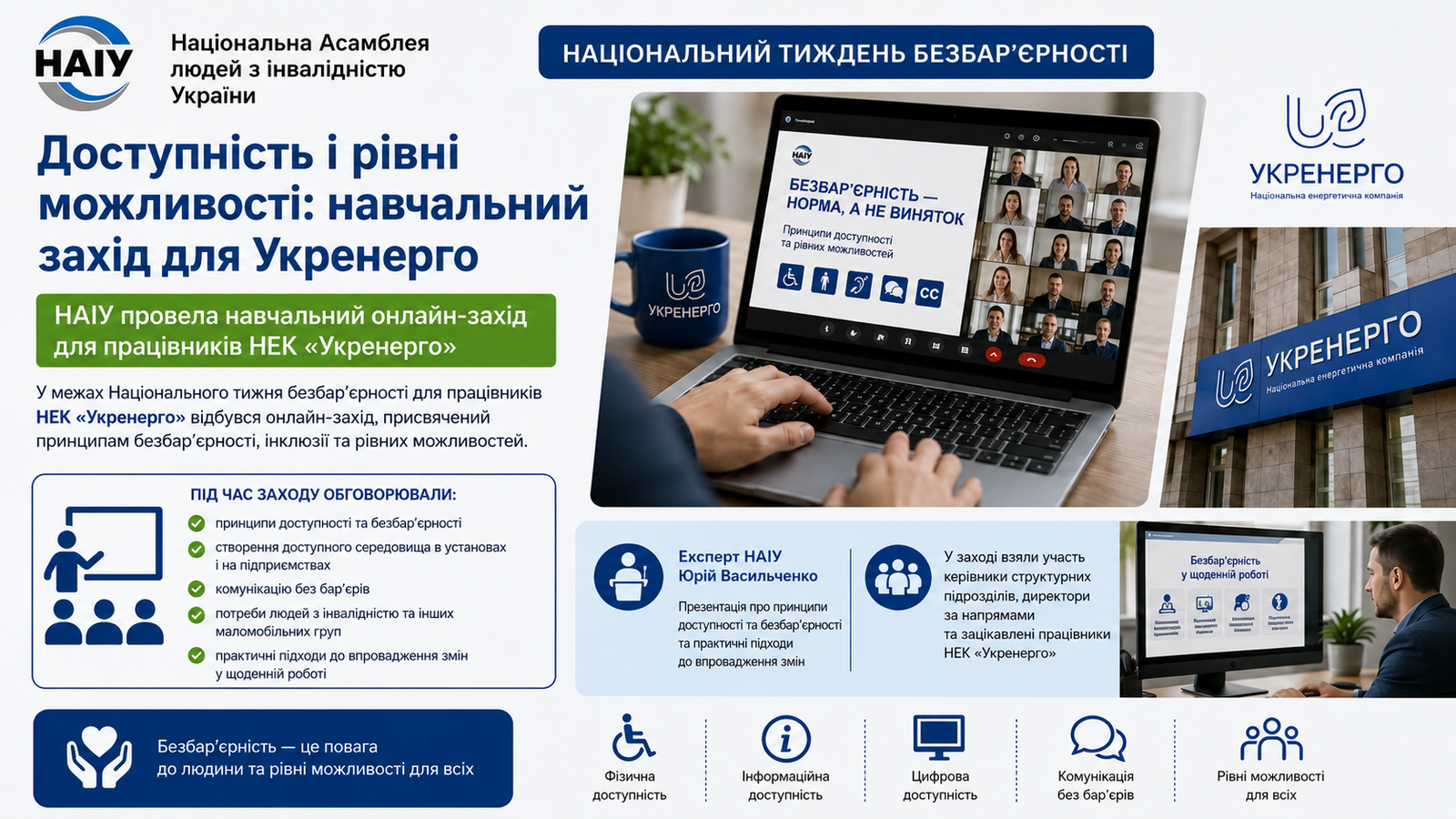
У межах Національного тижня безбар’єрності Національна Асамблея людей з інвалідністю України провела навчальний онлайн-захід для працівників НЕК «Укренерго» на тему «Безбар’єрність — норма, а не виняток». Захід був присвячений принципам доступності, інклюзії та рівних можливостей, а також практичним підходам до створення безбар’єрного середовища в роботі великих установ і підприємств. До участі в онлайн-зустрічі з боку […]
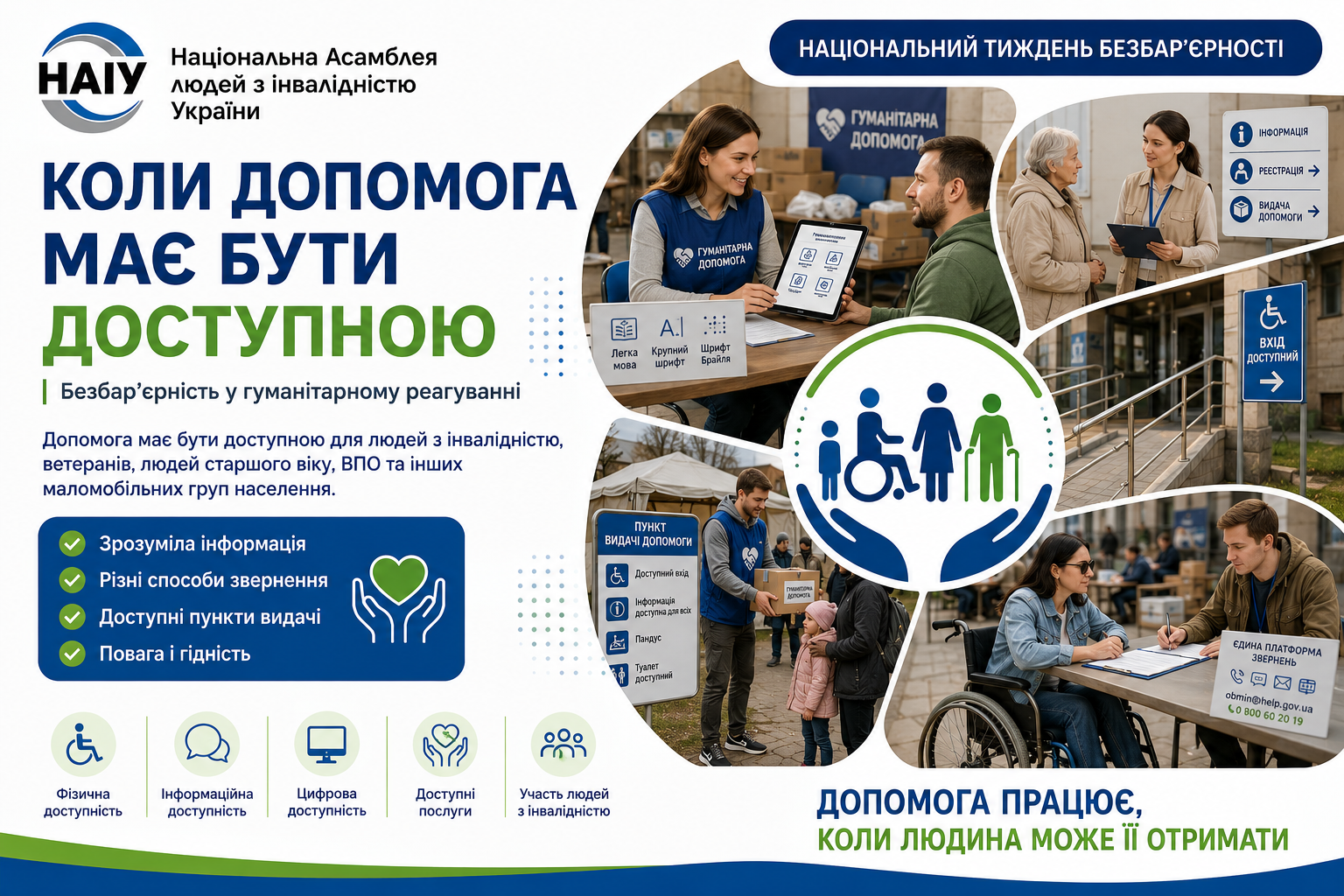
Національний тиждень безбар’єрності — це нагода говорити не лише про доступні будівлі, транспорт чи сайти. Це також привід подивитися на те, чи може людина вчасно отримати допомогу, коли вона їй найбільше потрібна. В умовах війни це питання стало особливо важливим. Люди з інвалідністю, люди старшого віку, ветерани з пораненнями, внутрішньо переміщені особи, родини з дітьми […]
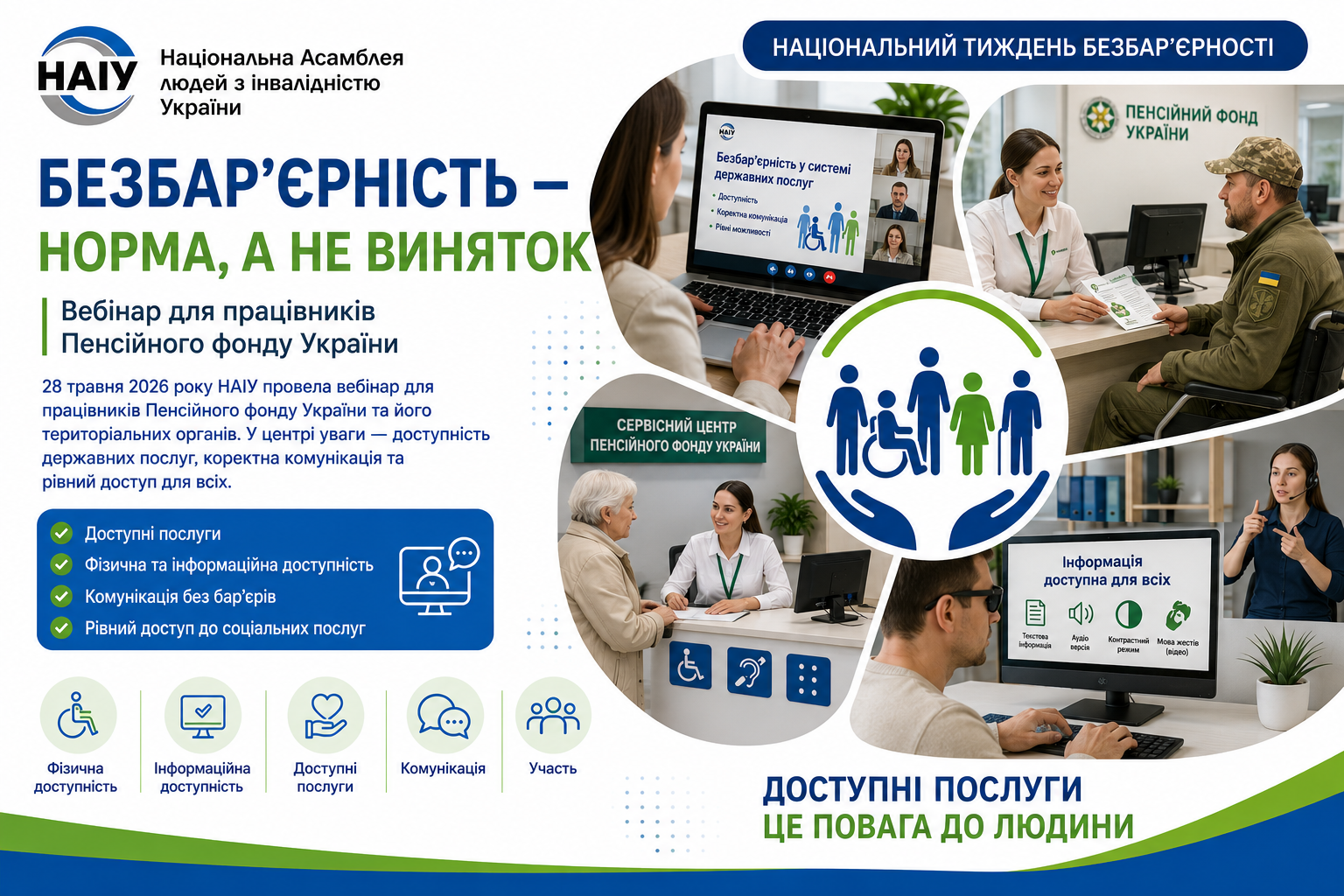
У межах Національного тижня безбар’єрності 28 травня 2026 року для працівників Пенсійного фонду України та його територіальних органів відбувся вебінар «Безбар’єрність — норма, а не виняток». У заході взяли участь Голова Громадської спілки «Всеукраїнське громадське об’єднання “Національна Асамблея людей з інвалідністю України”» Валерій Сушкевич, заступниця Голови правління Пенсійного фонду України Ірина Ковпашко, а також спікери […]
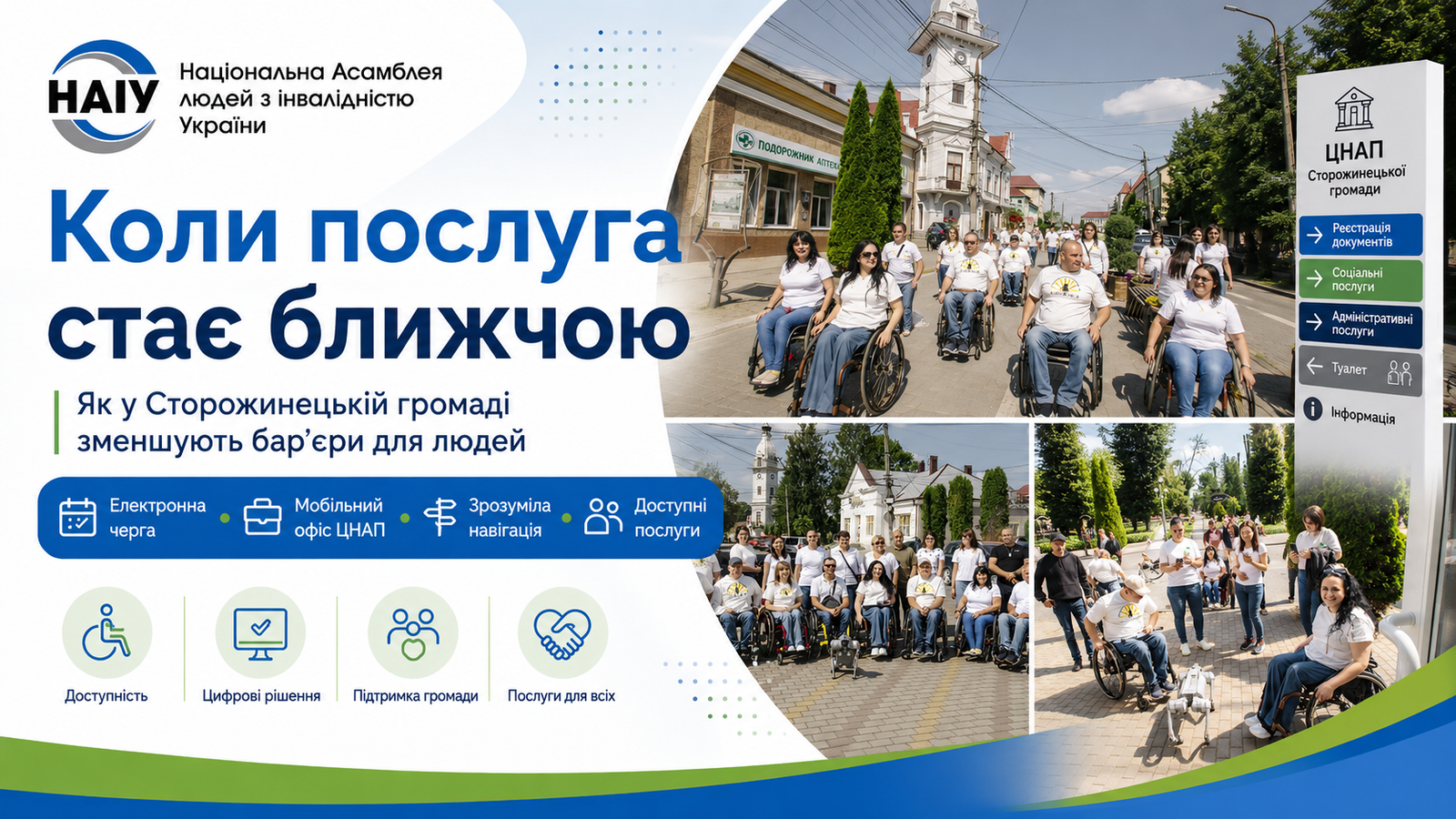
Доступність у громаді починається з конкретних речей. Людина має мати можливість зайти до установи, отримати послугу, знайти зрозумілу інформацію, звернутися по допомогу, дістатися потрібного місця і не залежати щоразу від сторонньої підтримки. Під час Національного тижня безбар’єрності НАІУ розповідає про приклад із мережі Асамблеї — роботу ГО «Чернівецька обласна організація людей з інвалідністю “Лідер”» у […]