When people talk about the life path of people with disabilities, it is most often a path of overcoming. Any achievements seem more significant when they are accompanied by a struggle against obstacles.
This struggle inspires people not to give up when faced with difficulties.
But do I see my path this way? I know very well how this world, which I cannot hear, limits my possibilities. And I also know very well the feeling of my limitless aspirations. Somewhere in between these two states - powerless helplessness in some situations and inspired motivation in others - is the path of my life.

I started losing my hearing when I was a child. But it was so gradual and unnoticeable that I gradually got used to the fact that I could hear less and less of the world around me. Because of this gradual adjustment, I did not undergo appropriate rehabilitation in time and did not receive a disability.
I went to a regular school with hearing students and an art lyceum, but I couldn't graduate from either the art or theater institutes because I couldn't hear what the teachers were saying and I didn't understand lectures in large classrooms for many students. In the late 90s and early 2000s, I didn't know what inclusion meant. So I just accepted the fact that I was expelled for not attending lectures. There were talks about some kind of individualized learning, but there was no understanding of how to do it.
So I communicated less and less with people and tried to work as an artist - in the puppet theater, in interiors (bas-reliefs, wall paintings, drawings on mirrors and glass). That's how I met my future husband, we worked together for a while and he was my "ears".
Then I gave birth to my son and gradually closed myself off in four walls, suffering from discommunication with the outside world, but not understanding what to do about it. This led to a deep depression. From which I was looking for a way out by communicating a lot on the Internet.
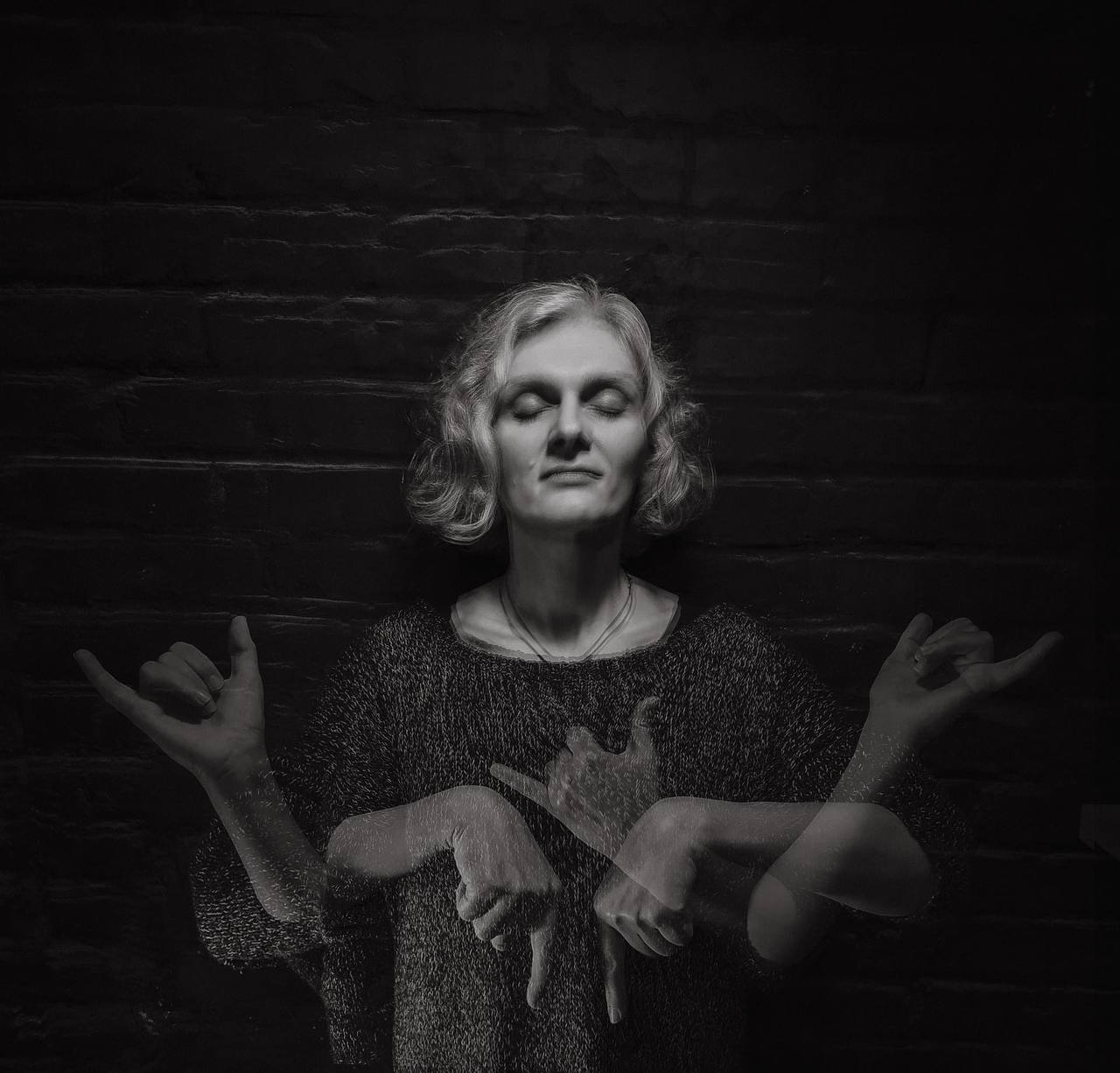
When I was 20, the head doctor of our Kharkiv ENT hospital told me that I should rely on the remnants of my hearing, practice lip reading, and that hearing aids would only make my hearing worse faster. I believed this and was faced with the fact that at the age of 35 I could hardly hear music and could not understand what people were saying to me.
It turned out that hearing aids no longer helped me and I needed a cochlear implant. At that time, I did not know that in Ukraine it was possible to perform this operation for a deaf adult free of charge. And it was quite expensive. And the decision was again postponed for several years.
But these years were filled with extraordinary activity, because I could no longer sit still, draw something in silence and suffer from depression. I started volunteering with the local eco-movement Kharkiv Zero Waste. I draw posters and infographics, sort waste, promote a conscious attitude towards environmental issues, and conduct workshops for children.
I felt that I could be an eloquent and inspiring speaker, got on TV, but I constantly struggled with the fact that I could not hear people and it caused a lot of inconvenience. Even on television, they didn't dare invite me right away because they feared that it was "technically impossible" to have a live broadcast with a deaf person.
Then I found an app on my smartphone that recognized speech. I started using it actively. It worked very incorrectly and sometimes refused to recognize voices at all - where it was very loud, or there were a lot of people, or the person spoke quietly or indistinctly.
But this did not stop me.
I approached human rights activist Maria Yasenovska with a desire to join the fight for human rights. To be useful in some way. I was inspired by her comment on Facebook that people with disabilities do not have any "special needs" but have the same need as all people to live a full life.
That was the first time I made a presentation about the problems of people with hearing impairments at the Accessible City roundtable. I felt that I was saying something important, about something that remains invisible and incomprehensible. That's how I learned that we must voice our needs out loud - "Nothing about us and for us without us!"
In fact, I was afraid that they would not listen to me and say that all the accessible conditions already exist, and I just don't know about it and live in my own closed world of silence. I carefully checked everything I was going to say about inaccessibility and barriers. But!
My mythical belief in the existence of some "special" people who deal with these issues and know how to solve them was shattered. In a single moment. It was enough just to dare to come to a place where officials, politicians, social workers and public figures gather to see that your knowledge, real experience of discrimination and fighting against non-inclusive environment is crucial information. It needs to be communicated confidently, clearly and precisely. To drive change for the better.
We also need to realize that it is very difficult to promote these changes and we have to be resilient in this struggle against the inertia of society, entrenched stereotypes and political power games. It is very important to study the real situation in order to better understand what can be done about it and how.
I am glad that I managed to maintain a good oral pronunciation and competent writing. This is a problem for many people who have hearing impairments and are educated separately in special institutions. My difficult path has taught me to be understood by others. And I am able to speak on radio, television, give interviews, write texts - without the help of a sign language interpreter.
Of course, I tried to learn sign language when I was looking for ways to overcome my discommunication with the world. But it turned out to be too difficult for me, and I never mastered the language to the point where I could communicate fluently. But after three months of studying it, I understood it and the world of sign language speakers, "sign culture" much better and deeper.
According to the WHO, there are about 13 % people like me on the planet - people with hearing impairments who do not speak sign language, while there are about 1 % sign language speakers. They are united by a common language and culture, while we remain invisible and scattered among the hearing.
My phone's voice recognition didn't work a miracle for me. But with its help, I became a curator of several author's social art projects. In cooperation with the Civic Alternative Foundation and the InclusiON festival, as well as the Center for Gender Culture.
These were projects about people with disabilities and survivors of domestic violence, because I have this experience myself and wanted to show these complex topics through performances, installations and works by different artists. One of my projects about domestic violence received an award from the UN Foundation. It was an incredible feeling - I couldn't believe that what I was doing was really that important.
This led me to the filming of the documentary Break the Cycle. After that, the director Elizabeth Smith and I started shooting a whole documentary epic about me, Listening to the world. This filming began before the full-scale invasion and is still ongoing. Now we are continuing to film my journey in Berlin.
In four years of activity, I managed to get a divorce, become more independent, try different jobs (even unskilled ones, such as washing windows or dishes, packing eco-flour). I learned a lot about myself and the world, traveled by train unaccompanied for the first time and attended many trainings and events. She studied at the Human Rights School at the Educational House of Human Rights in Chernihiv, participated in projects of the Fight for Right organization, and was an expert at various conferences and international forums.
On March 4, 2023, I was forced to leave Kharkiv with my 16-year-old son. In Lviv, I managed to restart my favorite Kharkiv project involving visually impaired people, "Modeling by Touch." Now the sculptor Vladyslav Yudin continues to explore this inclusive art practice together with the organization "Untrodden Path". Without my participation.
Because I settled in Germany. Here I managed to do what I could not do in Ukraine - get a hearing implant and get a disability. I am in the process of hearing rehabilitation. I take part in local trainings for Ukrainian activists. I even had the honor of speaking about the rights of refugees with disabilities in the Berlin parliament. Now I have gradually recovered from the stress and rehabilitation and have started working on my new social art project about auto-aggression and overcoming the trauma of violence.
I am still very hard of hearing and often use voice recognition and translator on my phone. I learn German in a group for people with hearing impairments and try to improve my poor English. My pronunciation is distorted because of my hearing loss.
I face challenges every day. And I don't consider myself a "special" strong person. I don't consider myself a "superhero". Because I remember well what it feels like to be completely helpless, dependent on other people, and afraid to do anything on my own. Sometimes I don't have the resources to fight. We all do. From time to time...
But there is something that helps you overcome obstacles and move forward. It's not giving up. This is the desire to live life to the fullest, to maximize your capabilities and this diverse world. Not to stay in the shadows - invisible and unheard.
That is why in recent years I have made so many friends from different walks of life. So many interests and plans.
Because the world has no boundaries. And it will be more accessible if we sincerely need it. If we are desperate to plunge into it, to live here and now. And thus change everything around us for the better.
By Tatiana Stetsenko
************
"Unbreakable" is a series of articles about Ukrainian women and girls that motivate, delight and inspire!
This initiative is being implemented within the framework of the project "Promoting the rights of women and girls with disabilities by strengthening their participation and leadership in communities", implemented by the National Assembly of Persons with Disabilities of Ukraine with the support of UN Women Ukraine and the Women's Peace and Humanitarian Fund.
About the United Nations Women's Peace and Humanitarian Fund (WPHF).
The Women’s Peace and Humanitarian Fund (WPHF) is the only global financing mechanism exclusively dedicated to supporting women’s participation in peace and security processes and humanitarian action. Governed by a diverse group of civil society, government, and UN representatives, WPHF is a multi-partner trust fund that mobilizes urgently needed funding for local, women-led organizations and works alongside women on the front lines to build lasting peace. Since 2016, WPHF has provided funding and strengthened the capacities of over 1,000 local women’s civil society organizations advancing the Women, Peace and Security agenda and delivering humanitarian action in 41 crisis-affected countries.
This publication has been prepared with the financial support of the United Nations Women's Peace and Humanitarian Fund (WPHF), which does not imply that the views and contents expressed herein are officially endorsed or recognized by the United Nations."
********
Iva Stishoon (Tetiana Stetsenko)
I V A:
When people talk about the life paths of people with disabilities, it is most often a path of overcoming something. Any achievement seems more significant when there is a struggle with obstacles behind it.
This struggle inspires people not to give up when they face difficulties.
But do I see my path this way? I know very well how this world, which I cannot hear, limits my possibilities. And I also know very well the feeling of my aspirations without limits. Somewhere in between these two states - overwhelming helplessness in some situations and inspired motivation in others - is the path of my life.
I started losing my hearing when I was a child. But it was so gradual and unnoticeable that I gradually got used to the fact that I could hear the world around me less and less. Because of this gradual adaptation, I did not have appropriate rehabilitation in due time, and I did not receive a disability status.
I attended a regular school together with hearing students and then an art lyceum, but I was unable to graduate from either the art or theater institutes because I couldn't hear well what the teachers were saying and didn't comprehend lectures in large classrooms for many students. In the late 90s and early 2000s, I didn't know what inclusion meant. So, I just accepted the fact that I would be expelled for not attending lectures. There were talks about some kind of individualized learning, but there was no understanding of how to do it.
So, I communicated less and less with people and tried to work as an artist - in the puppet theater and in interiors (bas-reliefs, wall paintings, drawings on mirrors and glass). That's how I met my future husband; we worked together for a while, and he was my "ears."
Then I gave birth to my son and gradually closed myself off inside four walls, suffering from the breakdown of communication with the outside world, but not understanding what to do about it. This led to a deep depression. From which I was seeking a way out by communicating a lot on the Internet.
When I was 20 years old, the chief physician of our Kharkiv otolaryngology hospital told me that I should rely on my residual hearing, practice lip reading, and that hearing aids would only make my hearing ability deteriorate faster. I believed what was said and then faced the fact that at the age of 35 I could hardly hear music and could not understand what people were saying to me.
It turned out that hearing aids would no longer help me, and I needed a cochlear implant. At that time, I didn't know that in Ukraine it was possible to have this surgery for a deaf adult free of charge. Otherwise, it was quite expensive. So, the decision was again postponed for several years.
But those years were filled with extraordinary activity because I could no longer sit still, draw something in silence and suffer from depression. I started volunteering at Kharkiv Zero Waste, a local eco-movement. I would draw posters and infographics, sort waste, promote a conscious attitude towards environmental issues, and conduct workshops for children.
I felt that I could be an eloquent and inspiring speaker. I got on TV, but I was constantly struggling with the fact that I couldn't hear people, and it caused a lot of inconvenience. As for television, they didn't dare to invite me right away fearing it was "technically impossible" to have a live broadcast with a deaf person.
Then I found a smartphone app that recognizes speech. I started using it actively. It worked very incorrectly and sometimes refused to recognize voices at all - if it was very noisy around or there were a lot of people, or the person spoke quietly or indistinctly.
But it didn't stop me.
I approached the human rights activist Maria Yasenovska with a desire to join the struggle for human rights. To be useful in something. I was inspired by her comment on Facebook that people with disabilities do not have any "special needs," but they have a need to live a full life like all other people.
That was the first time I made a presentation about the problems of people with hearing impairments at the "Accessible City" roundtable. I felt that I was saying something important, about something remaining unnoticed and misunderstood. That's how I learned that we must voice our needs out loud - "Nothing about us and for us without us!"
In fact, I was afraid that they would not listen to me and say that all the accessibility conditions already exist, and I just don't know about it and live in my own closed world of silence. I had carefully checked everything I was going to say about inaccessibility and barriers. But!
My mythical belief in the existence of some "special" people who deal with these issues and know how to solve them was shattered. Within a single moment. It was enough just to dare to come to a place where officials, politicians, social workers, and public figures gather to see that your knowledge, real experience of discrimination and fighting against non-inclusive environments is crucial information. The information that should be communicated in a confident, clear, and precise way. In order to drive change for the better.
We also need to realize that to promote these changes is very difficult and we have to be resilient in this struggle against the inertia of society, entrenched stereotypes, and power political games. It is very important to study the real situation in order to better understand what and how can be done about it.
I am glad that I have managed to preserve good oral pronunciation and correct writing. This is a problem for many people who have hearing impairments and are educated separately in special institutions. My difficult path has taught me to be understood by others. And I can speak on radio, television, give interviews, write texts - without the help of a sign language interpreter.
Of course, I tried to learn sign language when I was looking for ways to overcome my miscommunication with the world. But it turned out to be too difficult for me, and I never mastered the language to the level where I could use it fluently. Still, after three months of studying it, I understood it and the world of sign language speakers, the "sign culture" much better and deeper.
According to the WHO, there are about 13% of people like me on the planet who are deaf and do not speak sign language, while sign language speakers make up about 1%. They are united by a common language and culture, while we remain invisible and scattered among hearing people.
The voice recognition function in my phone didn't work a miracle for me. But with its help, I became a curator of several authors' social art projects. In cooperation with Kharkiv's regional foundation "Civic Alternative" and the InclusiON festival, as well as the Center for Gender Culture.
Those were projects about people with disabilities and people who went through domestic violence because I had this experience myself and wanted to show these complex topics through performances, installations, and works by different artists. One of my projects about domestic violence received an award from the UN Foundation. It was an incredible feeling - I couldn't believe that what I was doing was really so important.
This led me to the filming of the documentary Break the Cycle. After that, the director Elizabeth Smith and I started shooting a whole documentary epic about me - Listening to the World. This filming began before the full-scale invasion and is still in process. Now we are continuing to film my journey - this time in Berlin.
During the four years of activity, among the things I did was to get a divorce, to become more independent, to try different jobs (even unskilled ones, such as washing windows or dishes or packing eco-flour). I learned a lot about myself and the world, traveled by train unaccompanied for the first time, and attended many trainings and events. I studied at the Human Rights School at the Educational House of Human Rights in Chernihiv, participated in projects of the Fight for Right organization, and was an expert at various conferences and international forums.
On March 4, 2023, I was forced to leave Kharkiv with my 16-year-old son. In Lviv, I managed to restart my favorite Kharkiv project "Modeling by Touch" involving people with visual impairments. Now the sculptor Vladyslav Yudin continues to explore this inclusive art practice together with the organization "Untrodden Path." Without my participation.
Because I settled in Germany. Here I managed to do what I hadn't been able to do in Ukraine - to have a hearing implant and register a disability. I am going through rehabilitation of hearing. I take part in local trainings for Ukrainian activists. I even had the honor of speaking about the rights of refugees with disabilities in the Berlin parliament. Now I have gradually recovered from the stress and rehabilitation and have started working on my new social art project about auto-aggression and overcoming the trauma of violence.
I am still very hard of hearing and often use voice recognition and translator on my phone. I'm learning German in a group for people with hearing impairments and trying to improve my poor English. Because my pronunciation is distorted due to the hearing loss.
I face challenges every day. And I don't see myself as a "special" strong person. Or a "superhero." Because I remember well what it feels like to be completely helpless, dependent on other people, and afraid to do anything on your own. Sometimes I lack the resources to fight. Like we all do. From time to time...
But there is something that helps you overcome obstacles and move forward. It's not to give up. It is the desire to live life to the fullest and manage to learn your abilities and this diverse world as much as possible. Not to stay in the shadows - invisible and unheard.
That is why, in recent years, I have made so many friends from different walks of life. So many interests and plans.
Because the world has no boundaries. And it will be more accessible if we sincerely need it. If we are desperate to delve into it and live here and now. And, by doing so, change everything around us for the better.
Prepared by Tetiana Stetsenko
"THE INVINCIBLE LADY is a series of articles about Ukrainian women and girls that motivate, fascinate, and inspire.
This initiative is part of the project "Empowerment of Women and Girls with Disabilities by Strengthening their Involvement and Leadership in Communities," which is being implemented by the National Assembly of People with Disabilities of Ukraine with the support of UN Women Ukraine and the Women's Peace and Humanitarian Fund.
About the UN Women's Peace and Humanitarian Fund (WPHF)
The UN Women's Peace and Humanitarian Fund is a unified global financial mechanism designed exclusively to support the participation of women in peace and security building and humanitarian responses. Governed by a range of civil society, governments, and UN actors, WPHF is a multi-partner trust fund that mobilizes urgently needed funding for local women-led organizations and works together with women on the frontlines to build lasting peace. WPHF has provided funding and supported capacity building for more than 500 local civil society organizations working with the Women, Peace, and Security agenda and implementing humanitarian activities in 28 crisis-affected countries.
This publication has been prepared with the financial support of the United Nations Women's Peace and Humanitarian Fund (WPHF), but the views and contents expressed herein do not necessarily represent the official endorsement or recognition of the United Nations.