We all have our dreams and goals. For some, it's to jump with a parachute, for others to climb to the highest peak in the world, and for others to create something unique and magical. But not all of us are able to reach the end of our journey. We often stop when we encounter obstacles or when we have doubts.
So, dear reader, you have probably already guessed that today's story is about developing talent and making dreams come true, even when you live in a country where war is raging and constantly wake up to the sound of explosions. Since the beginning of the full-scale invasion, Kryvyi Rih has been subjected to numerous rocket attacks, which have already affected many people. But, despite the war, there is still another incredible girl Polina who loves her homeland and stays in Ukraine to bring victory closer with her talent. Talent is also a weapon if it is developed and improved. She was born with a musculoskeletal disorder, but she is not afraid of difficulties and finds clues everywhere and believes that everything is possible. So, let's get to know each other:
Hello, everyone. I'm Polina Livshits, I'm 31. Since childhood, I was fond of movies and couldn't imagine myself without books. I started reading adult literature right away, but for some reason, books with illustrations were not very interesting to me. And now I'm an aspiring writer with my own books and creative works. In addition, I work in movies and write screenplays.
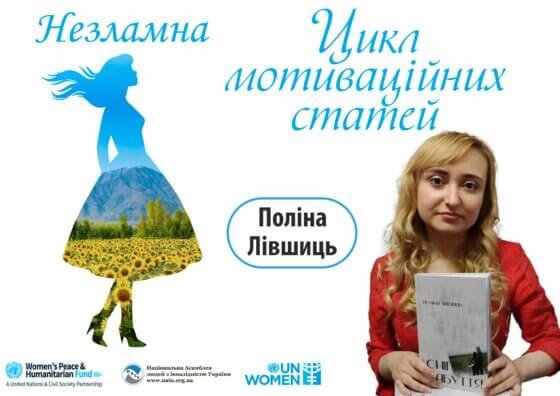
- When did you start writing fairy tales and short stories for children?
I probably started composing fairy tales when I was six or seven years old, my mother wrote them down, but I didn't know how to write yet because I started school late because I was sick. The first was a fairy tale about a little swallow. At the age of 8, I was already recording my own stories, and at 11, my collection Crystal Bell was published.
- Tell us how your first collection came about.
I participated in one of the competitions for children with disabilities and won first place. During the competition, I met the unfortunately deceased Anatolii Lipnytskyi, the editor of the local magazine-almanac Saksahan. He was the chairman of the jury and he liked my work. Mr. Lipnytsky asked for other works, read them, and suggested that I publish a collection. We argued for a long time about the title. There were a lot of suggestions, but I insisted on the option "Crystal Bell".
- What children's literary competitions have you participated in?
- When I was at school, I often participated in various children's competitions and festivals. In particular, I won prizes at the international festival "Lastochka", and every year I took part in the very popular competition "Cathedrals of our souls", which probably exists now.
- Where did you study after school?
After graduation, I had to take a break for a year because I was sick. After that, I passed the external independent evaluation and entered Kryvyi Rih State Pedagogical University and graduated with a bachelor's degree in part-time studies. However, I did not work in my specialty because I did not see any prospects. It was a forced choice to enter KSPU, as I thought at the time that I would not be able to get another profession because of my disability.
- Tell us about the international contest Coronation of the Word. How did it all start?
It was a children's fairy tale. I illustrated it and submitted it to the Young Coronation of the Word contest. Now I don't submit my work because being an expert is much more interesting. Although I didn't win any awards, I think I gained much more from the competition, such as the opportunity to study at Borys Grinchenko Kyiv University. I enrolled in a full-time master's program in literary creativity because it has all the conditions for people with disabilities and you can study online. Moreover, later the coronavirus pandemic began and all students had distance learning. During my studies, I was offered to become an expert at the Coronation of the Word.
- Was it difficult to combine your artistic activity with your studies at the B. Grinchenko Kyiv Polytechnic?
Combining study and creativity is not difficult at all. On the contrary, studying inspired me and made me do something. If only there was a little more time in the day, but otherwise everything is fine.
- In 2021, you presented your first novel, The Snow of Oblivion, a dystopia with action elements. Do you remember what it was like?
It was a meeting with readers. After all, as part of the book arsenal, each library held book presentations. So, at the level of our city, there was a presentation of my first novel, which was published in the winter of 2020.
- How did you come up with the idea for the dystopian novel Snow of Oblivion? What was the process of writing, editing, and publishing this novel like?
This happens to me rarely now, but more often in my youth: I have interesting dreams. They are plot-driven, like whole stories or movies, and I started writing them down, but I thought no one would need it. When I entered Borys Grinchenko Kyiv National University, I had to think about the topic of my thesis right away, because the master's program lasts only a year and a half. I met with my supervisor and told her about my novel. When she asked me what it was about, I shared my opinion that it was unlikely that anyone would read it because it was a dystopia. Unfortunately, science fiction is not a popular topic in Ukraine. So after the meeting, I had the idea to write my thesis, in which I would explore the history and development of dystopia, and publish this book. It seems that dystopia is always about the future, where everything is bad, there is a nuclear war and an apocalypse, or a dictator comes, but in fact it is a very interesting thing because you can talk about problems that are relevant today through fiction. I illustrated and edited this novel myself. The editing process was the most difficult. It's not difficult to edit someone else's text, but your own: when you see it 24-7, you don't notice mistakes. The whole text seems to you either very good or very bad.
- When did you start studying screenwriting?
I finished my master's degree and wanted to go to graduate school. I had already bought all the necessary literature and started actively studying a foreign language up to B2 level, because without it it was impossible to enter. And then my friends got together and gave me screenwriting courses. They knew that I was very fond of cinema - it was my childhood dream. I didn't expect this, because my friends didn't give it to me for my birthday, they just gave it to me. I went somewhere on business and was confronted with the fact: here are the courses, you've been wanting to do this for a long time, so why don't you try it? First I took one course, then another, then another, and I already had connections, and I immediately began to fulfill small orders.
- Tell us about the Rhythm Theater. When did you start playing in this theater?
Once, I was asked to write a short script for a video for the library and play a young reader. An amateur actress known in our neighborhood was also invited to play there, and we acted together in the video. I had long wanted to act somewhere, and she took me to the Rhythm Theater. It is over 60 years old. It is an amateur theater that has the title of folk theater. Because of the war, the theater's activities are on hold, but you can watch plays and concerts on our YouTube channel. We have won prizes at many international festivals, and it was interesting.
- What do you enjoy more, writing scripts or being an actress?
Writing scripts is my job, and acting in the theater is a hobby and a rest for the soul. When you enter a different character, it is a very good reset of the emotional state.
- Do you remember your first performance?
It was a reporting concert, and the theater director asked me to be the host because I had just joined the team and all the scenes were already rehearsed. I think I did a good job for my debut.
- Who is your idol or role model?
I don't have any idols as such. At every stage of life, there are people I admire and look up to.
- Do people close to you share your passion for literature and art?
If it wasn't for my parents, I wouldn't exist in every sense of the word. I am the kind of person who often doubts myself. They always motivate me and support me the most.
- What are you working on now?
I am currently working on a TV series, and I also have an idea for a new book. I've already written a lot of things, but I'm always working or studying... In short, I don't get around to it, or I just don't dare.
- What do you like to do in your free time?
I like to go to the countryside if I have the opportunity, and I relax there a bit. I love to draw, but I don't have enough time for it, and when I was a kid I even dreamed of becoming an artist.
- How did the war affect your work?
Last year, I wrote a lot of plays about the war, and now I feel that I need to add positive things to myself and society, I need to write about something else. In 2022, when the start of the full-scale invasion came as a shock to everyone, there was a need to put all my pain and anger on paper, and now I need to move on.
- Do you plan to offer your plays for theatrical productions?
I would like to, but few theaters are working now. I hope that after the victory we will show plays about the war as historical events that happened in the past.
- Polina, do you often talk about your disability? Have you ever had to hide it?
I never hide it, but on the contrary, when I meet people, I tell them about my disability so that there are no false expectations or impressions. I immediately say who I am and what my capabilities are, and the fact that there is a lot of hate and disdain everywhere, I just got used to living with it. Although, sometimes it seems to me that people treat others this way, regardless of whether they have a disability or not.
- Do you often get rejected for work as a writer or screenwriter because of your disability?
I have noticed that the more you are in a cultural environment, the less problems related to disability arise. They always appear at the everyday level.
- What advice would you give to other people with disabilities?
Although it is very difficult, accepting your disability and realizing that it will be much harder than for others. However, in the lives of healthy people, difficult situations also occur, because the path is never easy. If the path is easy, then it is worthless. My second piece of advice to people with disabilities is to be attentive and look closely at your friends.
- What are your wishes to your readers?
My only wish for everyone is to never give up. Even when you have a fall: take a break, rethink it, watch a good movie, read your favorite book, and remember to move on and achieve your goal. It is very bad to live without a goal. If you don't have one, look for one: it's an even harder path, but don't stop moving, find support and be careful, because there are traps everywhere!" Polina tells us about the true female power that gives rise to indestructibility. Despite the war, constant air raids and missile attacks that have been making Ukrainians suffer for a year and a half, she continues to create: writing scripts that tell the story of the present day so that descendants will remember who we are and how hard we fought for our independence. Her disability has not become an obstacle for her, she follows her own thorny path, and through her own creativity she popularizes the Ukrainian language, demonstrates national culture, because without culture, people forget their identity. Her ability to overcome life's traps, not to be upset by obstacles and always find solutions helps her not only to live but also to create. Polina preserves the national memory and tells others about the terrible events of the war through cinema and literature. she also does not lose hope for a happy future and encourages others to do so, even if life is not a fairy tale and there are no magicians in it.
By Tamila Koval
The Women’s Peace and Humanitarian Fund (WPHF) is the only global financing mechanism exclusively dedicated to supporting women’s participation in peace and security processes and humanitarian action. Governed by a diverse group of civil society, government, and UN representatives, WPHF is a multi-partner trust fund that mobilizes urgently needed funding for local, women-led organizations and works alongside women on the front lines to build lasting peace. Since 2016, WPHF has provided funding and strengthened the capacities of over 1,000 local women’s civil society organizations advancing the Women, Peace and Security agenda and delivering humanitarian action in 41 crisis-affected countries.
This publication has been prepared with the financial support of the United Nations Women's Peace and Humanitarian Fund (WPHF), which does not imply that the views and contents expressed herein are officially endorsed or recognized by the United Nations."
A GIRL WHO PRESERVES HISTORY AND GIVES HOPE
We all have our dreams and goals. For some, it is to jump with a parachute, for others to climb the highest peak in the world, and for others to create something unique and magical. But not all of us are able to reach the end of our journey. We often stop when we encounter obstacles or when we have doubts.
So, dear reader, you've probably guessed by now that today's story is about developing one's talent and making dreams come true, even when you live in a country where war is raging, and you are constantly woken up by the sound of explosions. Since the beginning of the full-scale invasion, Kryvyi Rih has been under numerous rocket attacks that have already affected many people. But, despite the war, an incredible girl Polina is still living in the city. She loves her homeland and stays in Ukraine to bring victory closer with her talent. Talent is also a weapon if it is developed and improved. She was born with a musculoskeletal disorder, but she is not afraid of difficulties and finds clues everywhere and believes that everything is possible. So, let's meet each other:
- Hello, everyone. I'm Polina Livshits, and I'm 31. Since childhood, I've been fond of movies and could't imagine myself without books. From the very beginning, I started reading books for adults because, For some reason, books with illustrations were not very interesting to me. And now I'm a beginner writer myself with my own books, creative works, and ideas. Besides thatI work in movies and write screenplays.
- When did you start writing fairy tales and short stories for children?
- I guess I started making up fairy tales when I was six or seven years old. My mother would write them down, as I couldn't write then yet as I started school late because of my illness. The first was a fairy tale about a little swallow. At the age of 8, I was already writing down stories by myself, and at 11, my collection of stories "Crystal Bell" was published.
- Tell us how your first collection of stories came out?
- I took part in one of the competitions for children with disabilities and won the first place. During the competition, I met the unfortunately deceased Anatoliy Lipnytskyi, editor of the local magazine-almanac Saksahan. He was the chairman of the jury, and he liked my work. Mr. Lipnytskyi asked me for other works, read them, and suggested that I publish a collection. We argued for a long time about the title. There were a lot of suggestions, but I insisted on the "Crystal Bell" title.
- What children's literary competitions have you participated in?
- When I was at school, I often participated in various children's contests and festivals. In particular, I won prizes at the international festival "Lastivka"[Swallow], and every year I took part in the very popular competition "The Cathedrals of Our Souls," which probably still exists today.
- Where did you study after school?
- After finishing school, I had to take a break for a year because of my illness. After that, I passed the external independent evaluation and enrolled at Kryvyi Rih State Pedagogical University and graduated with a bachelor's degree's degree through distance format of education. However, I did not work in my specialty area because I did not see any prospects. It had been a forced choice to enroll at KSPU, as it seemed to me at that time that I wouldn't be able to get another profession because of my disability.
- Tell us about the international contest "Coronation of the Word." How did it all start?
- It was a children's fairy tale. I illustrated and submitted it to the "Young Coronation of the Word" contest. Now I don't't submit my works because being an expert is much more interesting. Although I didn't't win any awards, I think I gained much more from the contest - the opportunity to study at Borys Hrinchenko Kyiv University. I entered the Master's program in literary writing as a full-time student because they have all the conditions for people with disabilities and you can also study online. Moreover, later the coronavirus pandemic started and all students had distance learning. When I was studyingI was offered to become an expert at the "Coronation of the Word."
- Was it difficult to combine your creative activity with your studies at B. Hrinchenko Kyiv University?
- On the contrary, the education inspired and motivated me to do something. If only there was a little more time in the day, but everything else was fine.
- In 2021, you presented your first novel, The Snow of Obliviona dystopia with the elements of action. Do you remember what it was like?
- It was a meeting with readers. Actually, as part of the Book Arsenal faireach library held book presentations. So, at the level of our city, there was a presentation of my first novel, which was published in the winter of 2020.
- How did you come up with the idea for the dystopian novel The Snow of Oblivion? What was the process of writing, editing, and publishing this novel like?
- This rarely happens to me now, but it was more often in my youth: I have interesting night dreams. They are plot-driven, like whole stories or movies, and I started writing them down, but I thought no one would need them. When I entered Borys Hrinchenko Kyiv University, I had to think about the topic of my thesis right away because the Master's The program lasts only a year and a half. I met with my academic supervisor and told her about my novel. When she asked me what it was about, I shared my opinion that it was unlikely that anyone would read it because it was a dystopia. Unfortunately, science fiction is not a popular topic in Ukraine. So, after the meeting, there came an idea to write a Master's thesis exploring the history and development of dystopia and publish this book. It might seem that dystopia is always about the future where everything is bad, and where a nuclear war and an apocalypse come, or a dictator comes, but, in fact, it is a very interesting thing because you can talk through fiction about problems that are relevant today. I illustrated and edited this novel myself. The editing process was the most difficult. It is not difficult to edit someone else's text, unless it is your own piece of writing: : when you see it 24/7, you don't't notice mistakes. The whole text seems to you either very good or very bad.
- When did you start studying screenwriting?
- I finished my Master's degree and wanted to go to the PhD school. I had already bought all the necessary literature and started actively learning a foreign language to have B2 level, because otherwise it was impossible to enroll. And then my friends teamed up and presented me with a screenwriting course. They knew I loved cinema - it was my childhood dream. I didn't'don't expect that because my friends didn't't gift it to me for my birthday - they just gave it to me. I went somewhere on an errand and then was put before the fact: here is the course, and you'have been wanted to do it for a long time, so why don't'don't you try it? At first, I took one course, then another, then one more, and I already had some connections and I started fulfilling small orders at once.
- Tell us about the "Rhythm" Theater. When did you start playing in this theater?
- Once, I was offered to write a short script for a video for a library and play a young reader in it. An amateur actress known in our neighborhood was also invited to play there, and we acted together in the video. I had long wanted to act somewhere, and so she took me to the Rhythm Theater. It is over 60 years old. It is an amateur theater that has the title of national [people's] theater. Because of the war, the theater's activities are on hold, but you can watch plays and concerts on our YouTube channel. We have won prizes at many international festivals, and it was exciting.
- What do you like more: writing scripts or acting as an actress?
- Writing scripts is my job, and acting in the theater is a hobby and a rest for the soul. When you enter a different character, it is a very good reset of your emotional state.
- Do you remember your first performance?
- It was a milestone reporting concert, and the director of the theater offered me to be the host because I had just joined the team and all the scenes were already rehearsed. I think I did a pretty good job for my debut.
- Who is your icon person or role model?
- I don't have any idols as such. At every stage of my life, there are people I admire and look up to.
- Do people close to you share your passion for literature and art?
- If it wasn't for my parents, I wouldn't exist in every sense of the word. I am the kind of person who often doubts myself. They always motivate me and support me the most.
- What are you working on now?
- I am currently working on a TV series, and I also have an idea for a new book. A lot has been written already, but I always either work, or studyIn short, either hands don't get it, or I just don't't dare.
- What do you like to do in your free time?
- I love going to the countryside, if I have an opportunity, where I relax a little. I love painting very much, but I don't have time for italthough when I was a kid, I even dreamed of becoming an artist.
- How did the war affect your creative work?
- Last year, I wrote a lot of plays about the war, and now I feel that it is necessary to add positive things to myself and society and it's necessary to write about something else. In 2022, when the start of the full-scale invasion was a shock to everyone, there was the need to put all the pain and anger on paper, and now I need to move on.
- Do you plan to offer your plays for staging in theaters?
- I would love to, but few theaters are working now. I hope that after our victory we will show plays about the war as historical events that happened in the past.
- Polina, do you often talk about your disability? Have you ever had situations when you had to hide it?
- I never hide it, but on the contrary, when I meet people, I tell them about my disability to avoid any false expectations or impressions. From the very beginning, I tell them who I am and what my abilities are, and as for much hate and disrespect everywhere - I just got used to living with it. Although sometimes it seems to me that people treat all others the same way, no matter if whether they have a disability or not.
- Have you often been denied cooperation as a writer or screenwriter because of your disability?
- I've noticed that the longer you are in a cultural environment, the fewer problems related to disability arise. Problems always appear at the everyday level.
- What would you advise our people with disabilities?
- Although it is very difficult, accept your disability and realize that it will be much harder than for others. However, difficult situations also occur in the lives of healthy people as well because the life path is never easy. If a life road is easy, then it is worthless. My second piece of advice to people with disabilities is to be attentive and look closely at your friends.
- What do you wish for the readers?
- My only wish for everyone is to never give up. Even when you have a fall: take a break, rethink it, watch a good movie, read your favorite book, and remember that you need to move on and achieve your goal. It is very bad to live without a goal. If you don't't have one, then look for one: it is an even harder path, but do not stop moving, find support, and be careful because there are traps everywhere!
Through her example, Polina tells us about the true female power that gives rise to invincibility. Despite the war, the constant air raids and missile attacks that have been making Ukrainians suffer for a year and a half already, she keeps on creating things: writing scripts to tell the story of the present day so that our descendants will remember who we are and how hard we have fought for our independence. Her disability has not become an obstacle for her; she walks her own thorny road, and through her own creativity she popularizes the Ukrainian language and demonstrates national culture, because without culture, a nation forgets its identity.
Her ability to overcome life's traps, not to be upset by barriers and always find solutions helps her not only to live but also to create. Polina preserves national memory and tells others about the terrible events of the war through film and literature. She also does not lose hope for a happy future and encourages others to believe too, even though life is not a fairy tale and there are no magicians in it.
Prepared by Tamila Koval
"THE INVINCIBLE LADY is a series of articles about Ukrainian women and girls that motivate, fascinate, and inspire.
This initiative is part of the project "Empowerment of Women and Girls with Disabilities by Strengthening their Involvement and Leadership in Communities," which is being implemented by the National Assembly of People with Disabilities of Ukraine with the support of UN Women Ukraine and the Women's Peace and Humanitarian Fund.
About the UN Women's Peace and Humanitarian Fund (WPHF)
The UN Women's Peace and Humanitarian Fund is a unified global financial mechanism designed exclusively to support the participation of women in peace and security building and humanitarian responses. Governed by a range of civil society, governments, and UN actors, WPHF is a multi-partner trust fund that mobilizes urgently needed funding for local women-led organizations and works together with women on the frontlines to build lasting peace. WPHF has provided funding and supported capacity building for more than 500 local civil society organizations working with the Women, Peace, and Security agenda and implementing humanitarian activities in 28 crisis-affected countries.
This publication has been prepared with the financial support of the United Nations Women's Peace and Humanitarian Fund (WPHF), but the views and contents expressed herein do not necessarily represent the official endorsement or recognition of the United Nations.