Accessibility in vocational education and training is not only about major renovations or new equipment. Quite often, change begins with solutions that an institution can introduce gradually: in learning materials, workshops, communication, work with parents, and cooperation with partners.
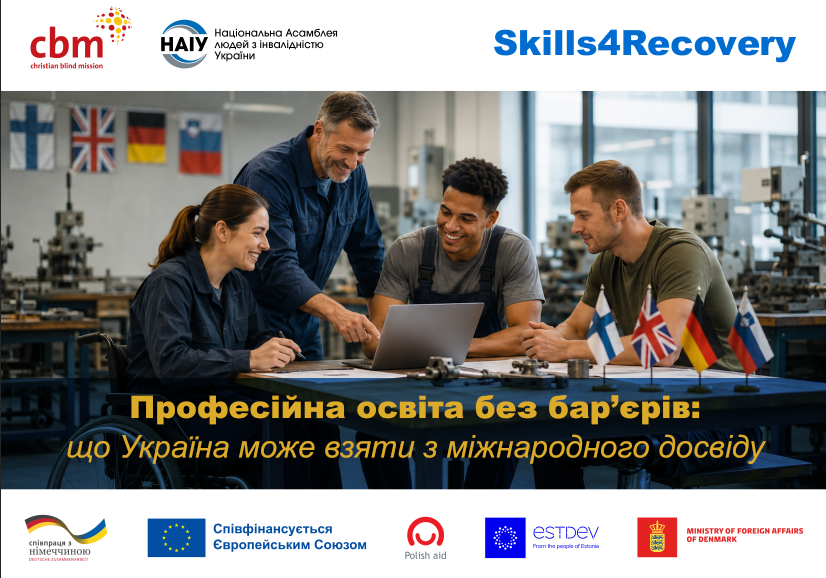
These were precisely the kinds of practical solutions discussed during the supervision sessions organised by the National Assembly of People with Disabilities of Ukraine in cooperation with Christoffel-Blindenmission Christian Blind Mission e.V. (CBM) as part of the project “Inclusive Vocational Education and Training (VET): Improving Training for Veterans and People with Disabilities”. The project is implemented within the Skills4Recovery Multi-Donor Initiative.
Teams from vocational education and training institutions examined real situations from their own practice. These were not theoretical examples, but everyday questions: how to explain an assignment more clearly, how to organise practical training more safely, how to prepare teachers, how to help a learner try out a profession, and how to attract resources when an institution cannot do everything on its own.
Through these discussions, a collection of solutions gradually took shape that may also be useful for other VET providers.
1. Breaking down a complex task into short steps
In vocational education and training, learners often need not only to understand a topic, but also to perform a specific action: prepare a dish, read a diagram, process a material, use a tool, or follow a technological process.
For some learners, lengthy explanations or extensive instructions may be difficult to follow. Therefore, one of the practical approaches is to break tasks down into short and clear stages.
For example, in cookery training, this may include cards showing the sequence of actions, photos of each stage, short videos, or simple graphic symbols. For technical occupations, this may include diagrams, enlarged technological process cards, demonstrations of individual operations, and repetition of key actions.
Such materials support not only learners with special educational needs. They make the learning process more understandable and more accessible for the entire group.
2. Use visual prompts in vocational workshops
A workshop is a place where accessibility must be highly practical. Safety, convenience, the pace of learning, and a clear understanding of the sequence of actions are all important here.
During the supervision sessions, participants spoke about solutions that are already working or could be introduced in VET institutions:
- enlarged technological instruction cards;
- diagrams placed near the workstation;
- photos of the expected final result;
- screens for demonstrating operations;
- clear placement of tools;
- visual markings on equipment;
- short instructions instead of long texts.
One example is the use of screens near machines so that learners can see technological operations in an enlarged format. This does not lower professional requirements, but it helps a person better understand the process and work with greater confidence.
3. Providing an Opportunity to “Try Out” a Profession
A person does not always know immediately whether a particular profession is right for them. This is especially important for veterans, persons with disabilities, adult learners, or those changing their profession after a difficult life experience.
For this reason, a short practical introduction to a profession can be a useful solution: a trial task, a demonstration, work on a simulator, familiarisation with tools, or a safe attempt to perform a simple action.
One of the VET institutions shared an experience in which a man who had lost his foot was invited to sit at a sewing machine and give it a try. He was able to work with the equipment, continued his training, and successfully completed it.
This approach helps us see not a person’s limitations, but their abilities.
4. Adapt the workplace without lowering standards
Inclusive training does not mean that professional requirements should be lowered. It is about something different: how to organise training in such a way that a person can safely acquire the required skill.
Sometimes, this requires simple adjustments:
- placing tools closer at hand;
- allowing more time to complete a specific action;
- preparing instructions in an accessible format;
- removing unnecessary distractions from the workplace;
- using a sample or a diagram;
- providing a mentor nearby during the initial stages.
For a VET institution, this is not a one-off form of support for a particular person, but a way to build a more flexible and higher-quality learning process.
5. Make the admissions-related information accessible
Even before the learning process begins, a person should be able to understand what professions the VET institution offers, how to apply, what documents are required, whom to contact, and whether support is available for persons with disabilities or veterans.
Therefore, the website, social media page, admission announcements, institutional presentation, or open day are also part of accessibility.
Practical steps may be simple:
- write briefly and clearly;
- avoid complex wording;
- provide a clear page structure;
- use sufficient contrast;
- do not overload images with text;
- provide the contact details of a person who can be approached;
- explain the available support options separately.
For a prospective student, this may be decisive: he or she will see that the institution is open to different people and ready for dialogue.
6. Work with parents as partners
During the supervision sessions, VET provider teams repeatedly spoke about the challenges of communicating with parents. In some cases, families do not disclose information about a child’s needs, have had negative previous experiences, or do not trust educational institutions.
However, without partnership with parents, it is more difficult for an institution to organise high-quality support.
What can help:
- speak with parents already at the admission stage;
- explain that information about needs is required not to impose restrictions, but to provide support;
- involve parents in the learner support team;
- provide clear feedback;
- discuss together what works and what needs to be changed.
This approach helps the institution better understand the learner’s needs and find solutions more quickly.
7. Do not leave educators alone with difficult situations
A teacher or vocational training master should not be expected to resolve all issues related to inclusive education on their own. Challenging situations require teamwork.
It is important for an institution to have people who can discuss a case together: the administration, a psychologist, a social educator, a vocational training master, a teacher, and, where necessary, specialists from an Inclusive Resource Centre, parents, or partners.
After the training, some VET institutions have already started holding internal meetings, discussing cases with colleagues, and setting up working groups or small methodological teams on inclusion.
This is important because knowledge should not remain with one person only. It should become part of the work of the whole team.
8. Look for partners if the institution lacks resources
There are issues that a vocational education and training institution cannot resolve on its own. These may include, for example, equipping a shelter, arranging an accessible sanitary room, purchasing adapted equipment, providing sign language interpretation, or upgrading workshops.
This is where partnerships become important.
VET institutions can cooperate with local communities, civil society organisations, Inclusive Resource Centres, employment services, employers, charitable foundations, alumni, and local businesses.
One example is preparation for training persons with hearing impairments, when a VET institution began looking for partners to support the educational process and provide sign language interpretation.
Such partnerships help transform an individual request into a practical solution.
Why These Steps Are Important
A larger font, visual instructions, a trial task, a more comfortable workplace, or a clear description of the admission process may seem like small things.
But for a specific person, they may mean something entirely different:
I can read the information.
I understand the task.
I can try out a profession.
I am not afraid to ask a question.
I have been taken into account here.
Real-life accessibility begins precisely with such decisions.
The Practice That Can Be Scaled and Rolled Out More Widely
The experience of VET providers shows that there is no need to wait for ideal conditions. Some changes can be introduced already now; others can be planned step by step. For more complex issues, partners and additional resources can be sought.
For vocational education and training, this is important not only as a matter of barrier-free accessibility. It is also a matter of training quality, trust in the institution, and readiness to welcome different learners: veterans, persons with disabilities, adult learners, internally displaced persons, and people seeking a new professional start.
When practical solutions become part of everyday work, inclusion ceases to be a separate topic.
It becomes a standard of vocational education and training.
The project “Inclusive Vocational Education and Training (VET): Improving Training for Veterans and People with Disabilities” is being implemented by the National Assembly of People with Disabilities of Ukraine (NAPD), jointly with Christoffel-Blindenmission Christian Blind Mission e.V. (CBM), with financial support from the European Union, Germany, Poland, Estonia, and Denmark as part of the Skills4Recovery Multi-Donor Initiative, which is implemented by Deutsche Gesellschaft für Internationale Zusammenarbeit (GIZ) GmbH and Solidarity Fund PL (SFPL).