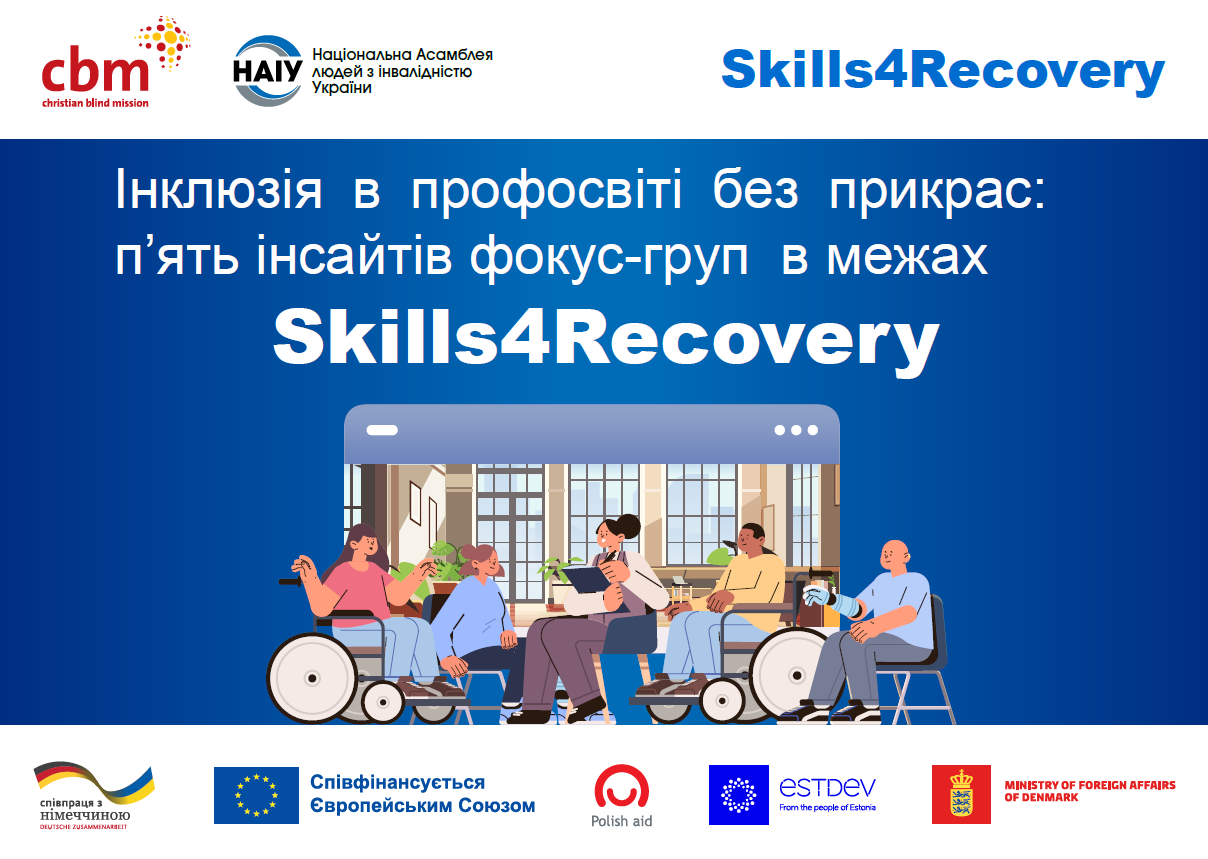
In December 2025, the National Assembly of People with Disabilities of Ukraine, in cooperation with Christoffel-Blindenmission (CBM), conducted five focus group discussions within the Skills4Recovery Multi-Donor Initiative to capture the actual state of inclusion in vocational education and training (VET). The participants’ responses were compared, key issues identified, and findings were supported with the participants’ own words.
The discussions involved 87 representatives, including administration members from Vocational Education and Training (VET) institutions, teachers, students, local government officials, and non-governmental organizations representing people with disabilities. The result is five insights that most accurately demonstrate where the system is already functioning and where it requires reinforcement – ranging from environmental accessibility and educational adaptations to support services and employment.
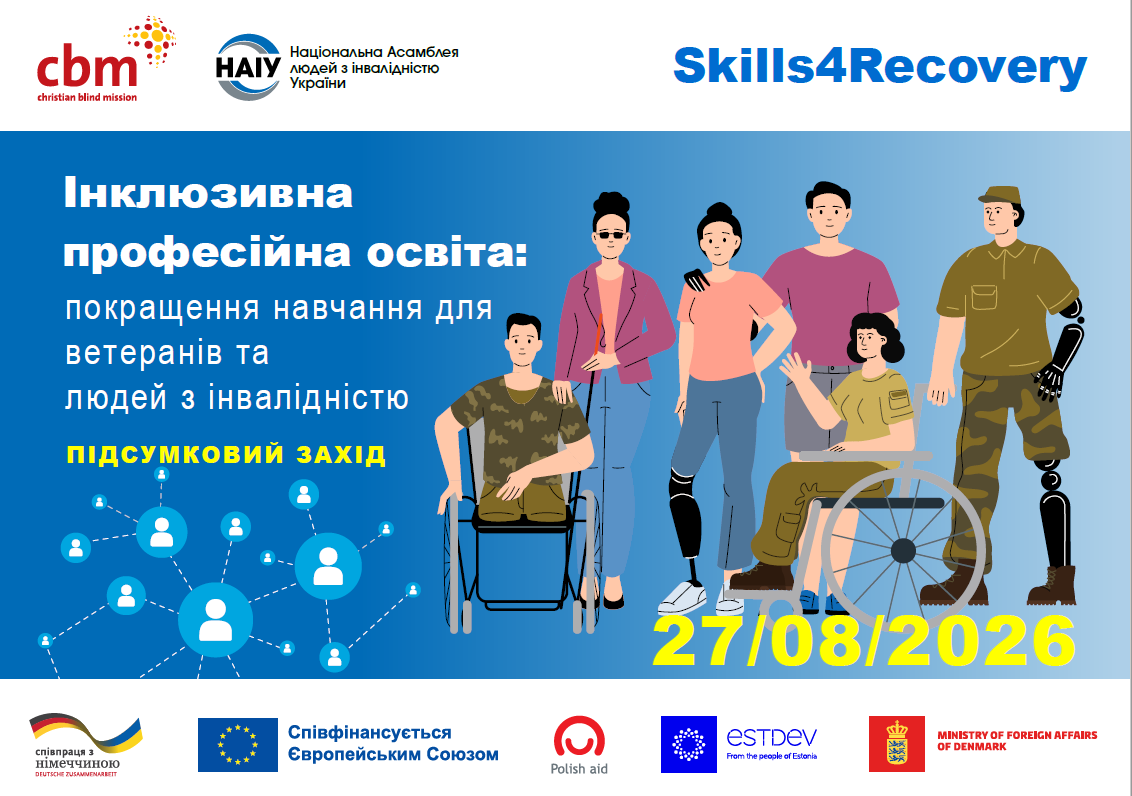
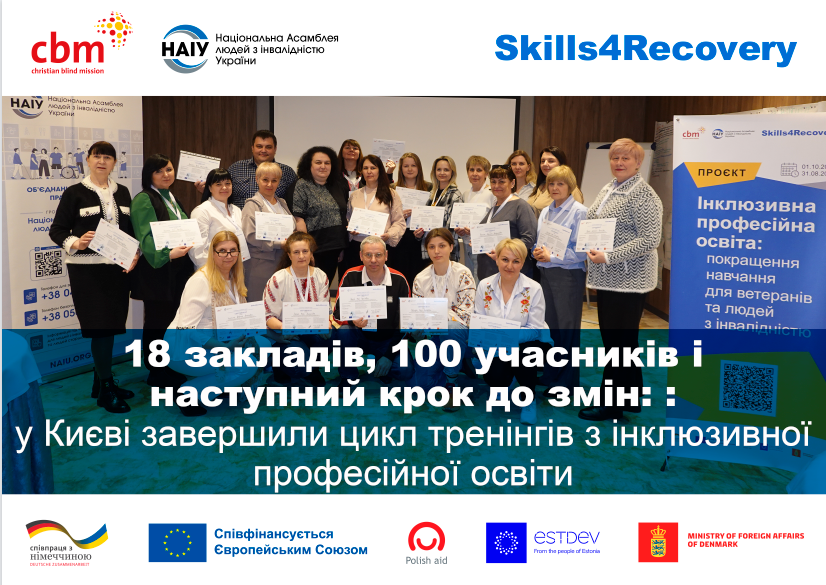
The project “Inclusive Vocational Education and Training: Improving Training for Veterans and People with Disabilities” helps 18 pilot VET providers in strengthening their inclusive approaches for training veterans and people with disabilities, while developing solutions that can be scaled across the national VET system.
Below are the five key insights that were shaped most clearly.
Insight 1. Everyone supports inclusion, but understands it differently
Participants describe inclusion as “accessibility for all,” yet each group places its own emphasis – on the learning process, conditions, attitudes, or employment opportunities.
Direct quotes:
- • “Inclusion means involvement. It is the inclusion of everyone into society.”
- • “Above all, inclusion is about creating conditions for safe learning.”
- • “…I would very much like teachers to really understand and support people with hearing or speech impairments, rather than criticize them – so that they truly understand and provide support.”
- • “For people with intellectual and mental disorders, vocational education often does not lead to employment in the profession they have trained for.”
What this means: there is a need for shared “rules of the game” — unified approaches and standards for inclusion specifically tailored to VET education.
Insight 2. Accessibility is often “spot-based”: solutions exist, but a person’s path is not integrated into a system
There are individual basic solutions in place; however, key elements of the learner’s pathway remain problematic: workshops, dormitories, shelters, inter-floor mobility, and sanitary facilities.
At the same time, accessibility in VET institutions is not only about infrastructure. In some institutions, learning materials are already being adapted (in terms of format, explanations, and distance-learning options). However, curricula are often outdated and do not always take into account the needs of persons with disabilities and veterans. Learners more frequently speak about support from teachers and the role of student self-government, whereas representatives of civil society organisations draw attention to stereotypes and lowered expectations regarding persons with disabilities, which affect both their learning experience and their future opportunities.
Direct quotes:
- • We all remember the years when our educational institutions were founded … they were not built in accordance with the requirements of our time.”
- • “We do not have convenient passageways, and the toilet cabins lack adequate space.”
- • “Workshops are even more inaccessible for persons with musculoskeletal impairments.”
What this means: Without a comprehensive approach – “from the entrance to the workshop and the shelter” – accessibility remains fragmented.
Insight 3. Simple accommodations work best, but they rely on specific individuals
VET providers implement practical accommodations: additional time, individualized solutions, relocating classes to the ground floor, and adapting equipment. These measures are effective; however, they often depend on the initiative of particular staff members rather than on established institutional procedures.
Direct quotes:
- • “We give her more time to complete this task so that she doesn’t feel anxious.”
- • “We designed special programmes for her… the class schedule was arranged exclusively on the ground floor.”
- • “The machine was personally adapted for him.”
What this means: there is a need to standardize practices and provide methodological guidance so that each new case does not have to start “from scratch.”
Insight 4. Support exists “on paper,” but is often absent in practice
The roles of assistants and support mechanisms are formally stipulated, but in many institutions they are missing due to staff shortages and limited resources. As a result, institutions attempt to “cover” these needs using their own internal capacity.
Direct quotes:
- • “The salary is quite low there. For example, we don’t have assistants.”
- • “So far, we don’t have assistants… we manage on our own.”
- • “The curator said there would be an assistant, but they couldn’t find one.”
What this means: Without a functioning support model and adequate resources, inclusion becomes an extra burden for an institution rather than an established standard.
Insight 5. The narrowest bottleneck: employment after training
Training alone does not guarantee results. The key barrier emerges at the stage of employment: employers may be unprepared to adapt workplaces; there may be a lack of time and resources, insufficient incentives, and, at times, a mismatch between the qualification obtained and a person’s actual capacities.
Direct quotes:
- • “Not a single person who completed the training has been able to find employment.”
- • “They (employers) need everything immediately and quickly. They don’t have the time.”
- • “Who is ready now to hire a person with a disability?”
What this means: Inclusion in vocational education and training must incorporate a transition-to-work component, including partnerships with employers, practical internships, workplace adaptations, and ongoing support.
What’s Next
The focus group findings present an evidence base for managerial decisions and practical steps within the project. The National Assembly of People with Disabilities of Ukraine (NAPD) will continue working with partners and educational institutions to move inclusion in vocational education toward a systemic standard — from accessibility conditions to the learning process, support services, and employment pathways.
The project “Inclusive Vocational Education and Training (VET): Improving Training for Veterans and People with Disabilities” is being implemented by the National Assembly of People with Disabilities of Ukraine (NAPD), jointly with Christoffel-Blindenmission Christian Blind Mission e.V. (CBM), with financial support from the European Union, Germany, Poland, Estonia, and Denmark as part of the Skills4Recovery Multi-Donor Initiative, which is implemented by Deutsche Gesellschaft für Internationale Zusammenarbeit (GIZ) GmbH and Solidarity Fund PL (SFPL).