
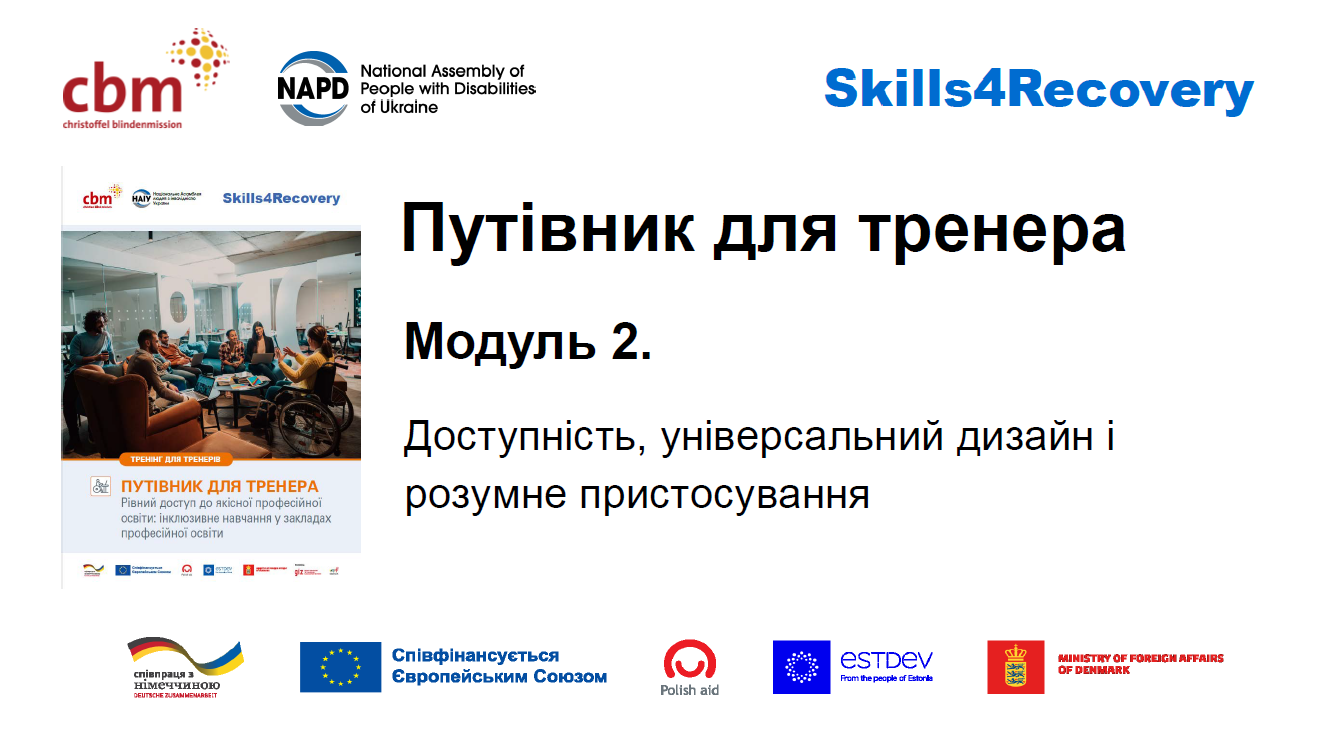
Module 2. Accessibility, Universal Design and Reasonable Accommodation
How can learning be organised so that the educational environment is convenient and accessible for various people – without having to create a separate solution every time?
The second module of the “Trainer’s Guide” focuses on accessibility, universal design, and reasonable accommodation – approaches that help make vocational education and training open to all learners.
The material introduces the seven principles of universal design and shows how to apply them in VET providers: when organising learning spaces, working in classrooms and workshops, completing work placements, using equipment, and preparing learning materials.
Particular attention is paid to the accessibility of information and communication. The module provides practical recommendations on fonts, contrast, presenting information in different formats, using plain language, pictograms, sign language, and other forms of communication that take learners’ diverse needs into account.
The module also explains what reasonable accommodation is, when it is required, and how individual solutions can enable a person to learn on an equal basis with others.
The material will help trainers, teaching staff, and managers of VET providers assess their own educational environment and identify practical changes that can make learning more accessible to diverse learners.
Module 2 is part of the "Trainer's Guide" developed within the framework of the project "Inclusive Vocational Education: Improving Learning for Veterans and People with Disabilities."
The project is implemented by the National Assembly of People with Disabilities of Ukraine together with CBM within the framework of the Multi-Donor Initiative Skills4Recovery.
The Multi-donor initiative Skills4Recovery is co-funded by the European Union, Germany, Poland, Estonia and Denmark and implemented by the Deutsche Gesellschaft für Internationale Zusammenarbeit (GIZ) GmbH and the Solidarity Fund PL (SFPL).
Similar publications
All editions