
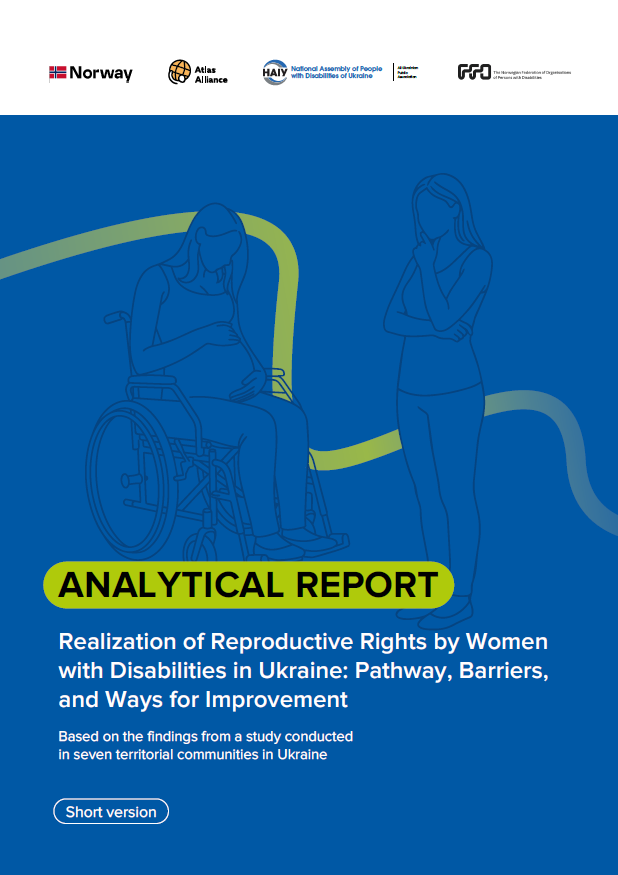
Analytical Report “Implementation of the Reproductive Rights of Women with Disabilities in Ukraine: Pathway, Barriers and Ways for Improvement”
Access to quality, timely, appropriate and affordable healthcare services, including reproductive health services, is a human right. For healthcare services to be inclusive and accessible to women and men with disabilities, they must be financially accessible, relevant to their needs, appropriate and acceptable. This includes access to information, including in sign language, Easy Read, plain language and Braille, as well as physical accessibility of the environment and the provision of appropriate support, reasonable accommodation, assistive products and technologies, and personal assistance.
The National Assembly of People with Disabilities of Ukraine (NAPD) has prepared the analytical report “Implementation of the Reproductive Rights of Women with Disabilities in Ukraine: Pathway, Barriers and Ways for Improvement.”
The study covered seven territorial communities. The online survey involved 373 women with different impairments and 107 healthcare professionals. An additional 20 women with disabilities participated in focus group discussions, while eight doctors took part in in-depth interviews.
One of the key findings of the study is that the rights of women with disabilities guaranteed by law are not always realised in practice. The gap between legislation and its practical implementation remains a major reason why women are unable to exercise their rights.
The main barriers include the physical inaccessibility of healthcare facilities and medical equipment; difficulties reaching healthcare facilities due to the lack of accessible low-floor public transport in communities or the absence of relevant services close to where women live; insufficient training and flexibility among healthcare professionals; a tendency among some doctors to make decisions on behalf of women rather than support their autonomous and informed decision-making, including recommending termination of pregnancy on the basis of a diagnosis; insufficient awareness among women and men with disabilities of their rights; and misconceptions about the healthcare needs of women and men with disabilities.
Only about one third of the women surveyed regularly visit a gynaecologist, while some have never had a gynaecological examination. Only a minority undergo regular screening, including Pap tests, breast examinations and mammography. Women who use wheelchairs undergo screening at substantially lower rates than the overall average because of the physical inaccessibility of examination rooms and medical equipment. Almost one in three participants encountered barriers in communication and interaction with healthcare professionals.
The publication is intended to serve as a practical tool for decision-makers, healthcare professionals and the human rights community and to contribute to removing barriers to accessing healthcare services.
The report was prepared as part of the Women’s Health project, implemented by the National Assembly of People with Disabilities of Ukraine with the support of and in partnership with the Norwegian Federation of Organisations of Persons with Disabilities and Atlas Alliance.
Compiled by: Larysa Bayda, Yevheniia Pavlova
Consultant: Yuliia Davydova, obstetrician-gynaecologist of the highest qualification category, Doctor of Medical Sciences, Professor
NAPD expresses its gratitude to the women with disabilities, doctors, consultants and coordinators of the pilot communities who contributed to the preparation of the report.
Oleksandra Perkova, Project Communications Manager